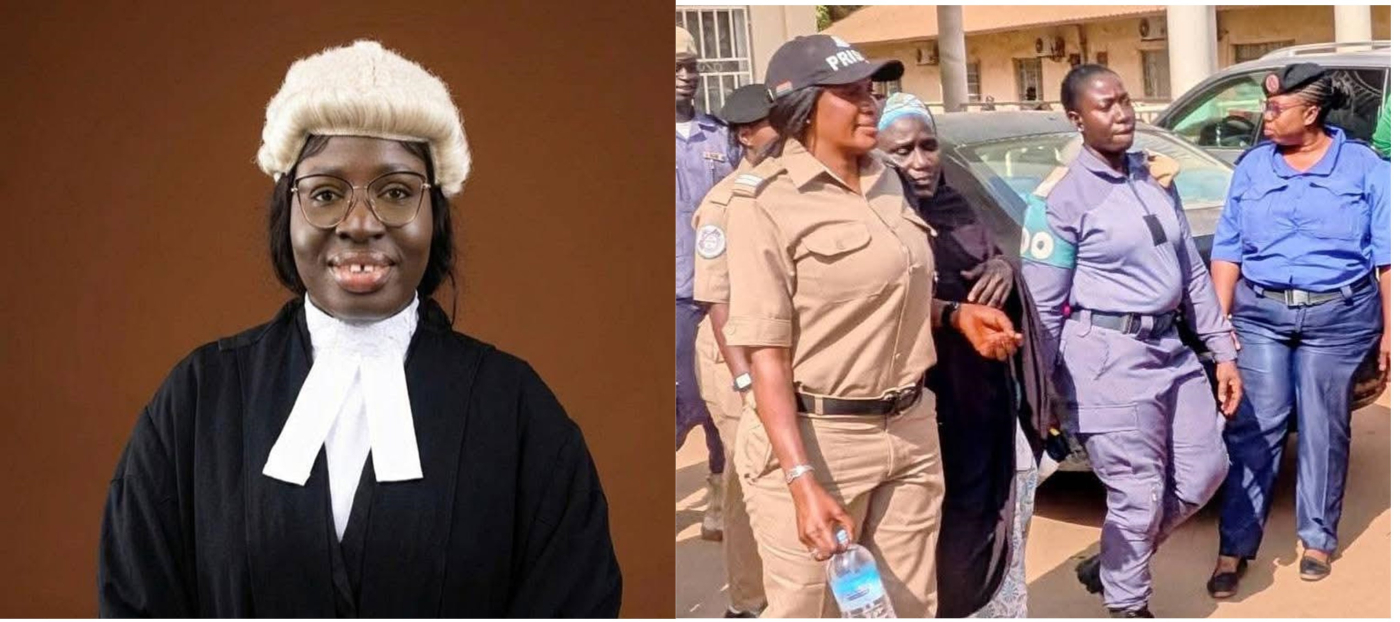
Upon arraignment, the accused respectively pleaded not guilty to the charges preferred against them, thereby placing upon the Prosecution the burden of proving its case beyond a reasonable doubt. In discharge of this burden, the Prosecution called ten witnesses and tendered exhibits in support of its case.
Their acquittal and discharge followed their lawyers’ filing a “No Case to Answer” application after the prosecution closed its case.
“At this stage of the proceedings, it is my humble view that the sole issue to be resolved is whether the prosecution has made out a prima facie case against the accused persons sufficient for the court to call on them to enter a defence to the charges respectively preferred against them?,” she said.
Hon. Justice Janneh said a prima facie case is not the same as proof beyond a reasonable doubt, which comes later when the court is to make a finding of guilt of the accused. She said it is evidence which, if believed and uncontradicted, will be sufficient to prove the guilt of the accused.
Bearing in mind the guiding principles, she said the basic responsibility or focus of court is to examine the evidence led by the prosecution witnesses in the light of the elements required to sustain the offences for which the accused are charged with and, in doing so, determine whether the evidence has failed to link the accused persons with the commission of the offences alleged against them so as not to require them to put in a defence.
On count 1, the three accused are jointly charged with the offence of conspiracy under Section 341 of the Criminal Offences Act, 2025.
Hon. Justice Janneh said the testimonies of the prosecution witnesses on this count are all hearsay evidence and were only admitted for the fact that the statements were made and not to establish their truth. She said the testimonies of PW4 and PW9 relate to alleged confessions made by the 2nd and 3rd accused which were rejected by the court for non-compliance with Section 31(2) of the Evidence Act.
Hon. Justice Janneh said the proof of conspiracy need not be direct, however, she found no admissible evidence of any meeting of minds, or admissible evidence of coordination or prior agreement.
“At best, the evidence raises suspicion, but suspicion is not proof of conspiracy. For these reasons, I find that the Prosecution has failed to adduce legally admissible evidence of any agreement between the accused persons to commit a felony to wit: performing female circumcision prohibited under section 32A of the Women's (Amendment) Act, 2015,” she ruled.
On count 2, the 1st accused is charged with the offence of prohibition of female circumcision contrary to Section 32A (2b) of the Women's (Amendment) Act 2015.
Hon. Justice Janneh ruled that the observations made by PW1 and PW2 and the evidence from the medical personnel and the pathologist indicate that female circumcision was performed and it resulted in death.
However, she further ruled that aside from the hearsay evidence presented, there is no direct eyewitness testimony or conclusive forensic evidence or even admissible circumstantial evidence tying the 1st accused to the physical act of circumcision.
She said the evidence, at best, only places the offence as having occurred, not the identity of the perpetrator.
“Based on the foregoing. I find that there is proof of death caused by genital injury, but no legally admissible evidence linking the 1st accused to the act,” she said.
The 2nd accused is charged under count 3, for being an accomplice to female circumcision contrary to Section 32B (1) of the Women's (Amendment) Act, 2015.
Hon. Justice Janneh ruled that aside from the testimonies of PW4 and PW9 whose evidence is inadmissible because they were based on rejected confessions, the remaining evidence is that of PW1 and PW2 who testified that the 3rd accused informed them that the child was taken by the 2nd accused for circumcision.
“These are evidence of hearsay and they cannot, on their own, be sufficient to prove the offence charged. The evidence is largely inferential and weak,” she said.
On count 4, the 3rd accused is also charged for being an accomplice to female circumcision contrary to Section 32B sub-section (2).
Like the three counts, Hon. Justice Janneh said the evidence in support of this count is the hearsay evidence of PW1 and PW2 and the inadmissible evidence of PW4.
“Aside from this evidence, there is no legally admissible evidence on which the Court can rely to rule that the elements highlighted above have been satisfied,” she ruled.
Hon. Justice Janneh said on the totality of evidence before the court, there is clear evidence that female circumcision indeed occurred on the deceased, Baby Sarjo Conteh, leading to her death. However, she said it is apparent that there are significant gaps in establishing all the necessary elements for all counts particularly in the sense of linking the accused to the offences charged.
“It is on the basis of the foregoing that this Court ruled that the Prosecution failed in establishing a prima facie case on all the charges against the accused persons. The evidence presented by the Prosecution is largely based on hearsay which this Court cannot rely on to rule that the Accused persons committed the acts they are alleged to have committed,” she said.
Hon. Justice Janneh said calling the accused to enter a defence would be unsafe and contrary to established principles of criminal justice and also a violation of their constitutional right of presumption of innocence until proven guilty guaranteed under S. 24 (3) (a) of the 1997 Constitution.
“Accordingly, the no case to answer submission filed on behalf of the 1st Accused person and also on behalf of the 2nd and 3rd Accused persons, both filed on the 18 of April 2026 succeeds and the same is upheld. The accused persons are hereby accordingly acquitted and discharged on all counts,” she ruled.