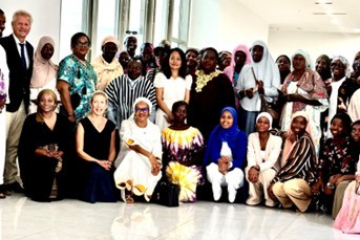
The organisation was founded by prominent legal practitioner Lena Hydara, whose extensive background in charitable service laid the groundwork for what has now become a coordinated humanitarian platform. Co-founder Aisha Hydara, a British-Gambian author and Inventory Systems Controller, brings international experience and operational expertise to the Foundation’s expanding portfolio of initiatives.
The executive leadership includes legal practitioner and ATI Commissioner Ya Amie Touray, supported by Ya Penda Bah, Mariama Suso (Misma), Maimuna Jallow and Maimouna Aidara. Oversight is provided by a Board of Advisors comprising respected professionals such as Ms. Fatou Fatty, Alhaji Ousman Jah, Dr. Mariama Njie, Momodou Mballow, Ya Marie Jack and Ndeye Amie Jallow. This governance structure ensures program integrity, financial transparency and strategic direction.
Expanding Ramadan Outreach
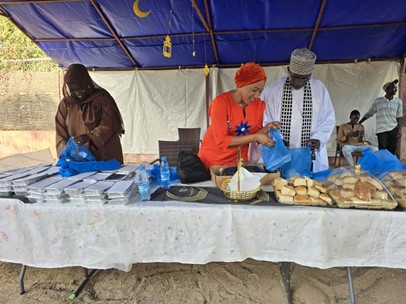
Among its most recognised initiatives is the annual Ramadan Iftar Programme, which continues to grow in scale and community outreach. During last Ramadan, more than 10,000 individuals across various communities received meals through the Foundation’s distribution efforts.
In addition to community outreach, HAF extended support to the Mile 2 prison facility, recognising the importance of inclusion during the holy month. The Foundation also facilitated the distribution of sacrificial animals during Eid-ul-Adha, enabling underprivileged families to participate meaningfully in the celebration.
Looking ahead, HAF has again erected an Iftar tent in Fajara to serve daily meals throughout Ramadan, complemented by weekly outreach to other regions. The Foundation also intends to scale up food parcel distributions, comprising staples such as rice, oil, sugar and broaden its Qurbani program to reach more households.
A Multi-Pillar Approach to Community Development
Beyond seasonal interventions, HAF’s work is anchored in 5 core programme areas:
- Food Security and Emergency Relief
- Rehabilitation of Mosques and Prayer Facilities
- Development of Community Mortuary Infrastructure
- Educational Assistance and School Support
- Healthcare and Sanitation Access
Through these pillars, the Foundation seeks to balance immediate relief with long-term development outcomes. Activities include renovating places of worship, supporting electricity access for religious spaces, providing school supplies and uniforms, distributing hygiene materials and installing refrigeration facilities in mortuary centres where such infrastructure is lacking.
Governance and Accountability
HAF emphasises structured beneficiary selection and financial accountability. A need-based assessment framework is used to identify recipients, prioritising low-income households, single-parent families, elderly individuals, persons with disabilities, and those facing food insecurity.
All major initiatives undergo board review and are implemented by trained volunteers, with documentation maintained to ensure transparency for donors and stakeholders.
As it broadens its impact, the Foundation is encouraging partnerships with development agencies, private sector institutions, philanthropic individuals, Diaspora networks and government bodies. According to the Founder, “Our vision is not only to provide immediate relief but to establish community-centred systems that foster resilience and dignity.”
With expanded programming and strategic collaboration, Hayatt Aid Foundation aims to remain a reliable pillar of humanitarian support serving communities not only during Ramadan but throughout the year.
For partnership enquiries or contributions, contact:
Hayatt Aid Foundation
Off Atlantic Road, Fajara, KMC, The Gambia
Email: hayattaidfoundation@gmail.com
Tel: +220 3634434 | +220 7554414 | +220 9900479