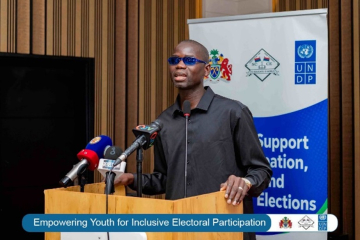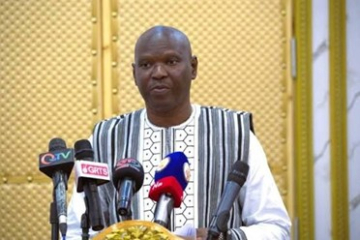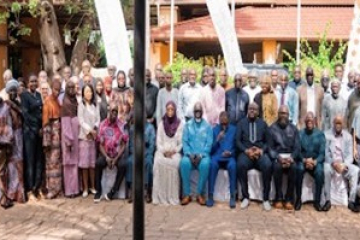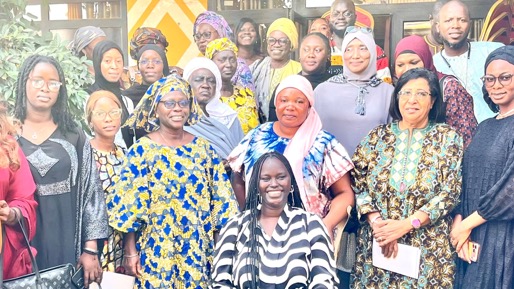
The one-day training, held at Bakadaji Hotel under the Governance for Inclusive and Accountable (GIA) Programme 2025–2026, brought together political actors, civil society leaders, media practitioners and aspiring female politicians to advance coordination and collective advocacy aimed at increasing women’s representation in decision-making spaces.
A total of 40 participants attended the forum, including 23 women and 17 men, among them 20 young people aged between 18 and 35 years , as well as representatives of Persons With Disabilities (PWDs). Participants spanned political parties and institutions, including the Vice Chair of the National Assembly Select Committee on Gender, Children and Social Welfare, members of the Inter-Party Committee, party leaders and activists.
Opening the session, WFD Country Director Mrs. Tabu Njie Sarr underscored that democracy thrives only when inclusion is genuine and not symbolic.
“When WFD opened its country office in The Gambia in 2018, we were guided by a simple belief; democracy is stronger when every Gambian, regardless of gender, age or ability, has a voice and a fair opportunity to influence decisions that shape their lives,” she said.
Mrs. Sarr highlighted WFD’s longstanding partnership with the National Assembly, describing it as one rooted in shared learning and collective commitment to democratic reforms that reflect the will of the people.
She stressed that inclusion in the Gambian context must go beyond election-time visibility, noting that women must be heard, respected and represented from community spaces to the highest decision-making chambers.
“With support from the FCDO through the GIA Programme, WFD is implementing the Women in Political Leadership project, one of whose key milestones was the establishment of the Women’s Political Coordination Network in October 2025,” she explained.
According to her, the Network was born out of a shared realisation that women are more effective agents of change when they work together across political divides, institutions and backgrounds. She described the platform as one built on solidarity, resilience and collective action in the face of persistent barriers to women’s leadership.
Mrs. Sarr noted that the training was designed not as a routine workshop, but as a space for reflection, dialogue and learning, urging participants to strengthen bonds that would sustain the Network beyond the project cycle.
“We must build a democracy where Gambian women are not sidelined, but confidently prepared and actively leading at the decision-making table,” she concluded.
Speaking on behalf of the Network, Ms. Ndegen Jobe, President of NOW-PaL, said the organisation was established at a critical moment as The Gambia enters a competitive election cycle that will include presidential, parliamentary and local government polls.
She said NOW-PaL was formed to confront long-standing gaps in women’s political participation and leadership, stressing that deliberate action is required to close these gaps and ensure women are fully represented at all levels of governance.
Ms. Jobe emphasised the power of solidarity among women, noting that sustained collective action and grassroots advocacy within political parties remain essential to amplifying women’s voices in politics.
She commended WFD for its support in establishing NOW-PaL, describing the Network as a timely and strategic platform to advance women’s leadership and participation in The Gambia’s democratic process.
The training featured expert presentations and interactive discussions, allowing participants to share experiences, exchange ideas and explore strategies for strengthening women’s political coordination and advocacy ahead of the upcoming elections.