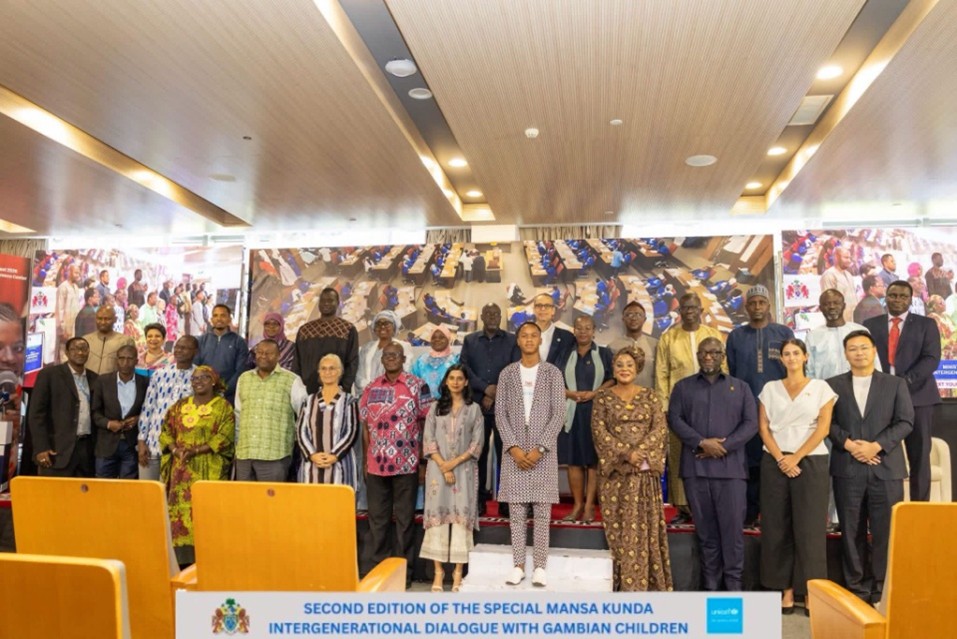
Organized by the Ministry of Information, Media and Broadcasting Services in partnership with the Ministry of Gender, Children and Social Welfare, with support from UNICEF and related UN agencies, the initiative seeks to amplify the voices of children and youths in critical areas of national discourse and development.
The dialogue focused on education, child protection, health and nutrition, climate change, digital inclusion, and poverty and social protection. Children called for access to quality schooling, particularly for girls and children in rural areas, improved WASH facilities for menstrual hygiene, an end to child marriage, FGM, gender-based violence, abuse and exploitation, improved healthcare, mental health support and nutrition programmes.
In his remarks the minister of Information, Media and Broadcasting Services, Ismaila Ceesay, said the dialogue was not only about asking children what they think, but also about asking government what it had done since children spoke to it during the first Special Mansa Kunda.
“Consultation without follow-up is not meaningful participation,” he said, stressing that children’s recommendations must not remain on paper but should inform policy, programs and projects.
He said children were stakeholders in the development of the country and urged them not to be afraid to ask questions or challenge government.
The Speaker of the Children’s National Assembly, Hon Babacarr Sowe, said the dialogue provided an opportunity to review progress made on previous commitments and strengthen accountability for promises made to Gambian children.
He said children continue to face poverty, child marriage, violence, harmful practices, substance abuse and online bullying, while children with disabilities continue to face barriers.
He called for children’s voices to be listened to, valued and turned into real action.
For his part, Karl Frederick Paul, UN Resident Coordinator to The Gambia, described Mansa Kunda as a platform for dialogue, accountability and children’s engagement with decision-makers.
He said the initiative gives children and adolescents the opportunity to speak directly with Cabinet ministers, share their priorities, concerns and suggestions and influence decisions affecting their lives.
Paul urged policymakers to listen with an open mind and consider how children’s concerns can be reflected in national policies, sector plans and budget priorities.
Fatou Kinteh, the Minister of Gender, Children and Social Welfare, said child protection was a national obligation requiring action from government, communities, families and children themselves.
She said children continue to face violence, abuse, exploitation, child marriage, trafficking, harmful traditional practices, online abuse and climate-related vulnerabilities.
Kinteh said government had made progress in strengthening legal and policy frameworks, expanding social welfare services and improving case management and community-based child protection structures.
She called for stronger enforcement of child protection laws, increased investment in education, health, nutrition and social protection, professional social services and stronger coordination among stakeholders.