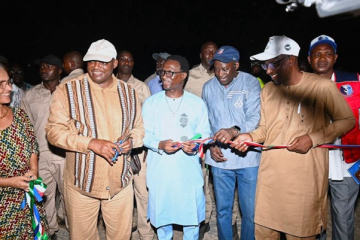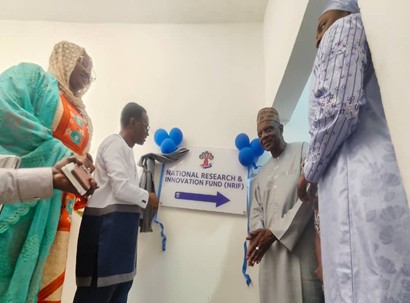
The launching ceremony was held on Tuesday 10 March 2026, marking a significant institutional milestone as the fund transitions from statutory establishment to full operational delivery.
The event brought together senior government officials, members of the NRIF Board, development partners, leaders from academia and industry, innovators and other key stakeholders within the national research and innovation landscape.
Amongst the key mandates, NRIF is designed to finance research and innovation, build research capacity, and advance national development.
NRIF is also committed to powering research, driving innovation and enabling transformation.
In his key note address, Minister Gomez revealed that the initiative underlined a structural turning point, where The Gambia now has a dedicated, capitalised and governed national institution whose sole mandate is to invest public and private resources in the creation and application of knowledge for national development.
He said that globally, the evidence is unequivocal, that countries that have sustained investment in research, science and technological innovation have built stronger foundations for economic growth, industrial competitiveness, and effective public policy.
He revealed that through this, they have done so not by accident, but by deliberate institutional design; by creating the precise kind of funding architecture that they have inaugurated.
The establishment of the NRIF, he said, reflects the government's determination that national challenges require not only policy commitment, but also the systematic generation of evidence, the cultivation of innovation, and the development of context-appropriate solutions grounded in Gambian realities.
Prof Gomez said that this NRIF is anchored in the Recovery-Focused National Development Plan 2023-2027, which identifies science, technology and innovation as essential drivers of economic transformation and sustainable development.
He said: "The Fund's four financing instruments, spanning from foundational research at Technology Readiness Level 1 through to prototype-to-market commercialisation at TRL 9, are specifically calibrated to address priority areas including agricultural resilience, climate adaptation, health systems strengthening, youth skills development, and industrial diversification."
He emphasised that the NRIF's mandate is not abstract, noting that its research grants will reach the laboratories of USET, UTG, and the University of Education.
He assured that its applied technology windows would support NARI's work to reduce post-harvest losses and strengthen food security.
He noted that its innovation and commercialisation instruments will work alongside UNiPOD, the national innovation hub hosted at USET, to help Gambian entrepreneurs take ideas to market.
He stated that its challenge-driven calls will be designed in response to the national priorities that the government has set, including climate resilience, digital transformation and health equity.
He said the NRIF enters full operation at precisely the moment when the government is finalising the National Science, Technology and Innovation Policy 2027-2035; a comprehensive, nine-year national framework that will govern the development and governance of the nation's entire STI ecosystem through to 2035.
Professor Momodu Sallah, NRIF executive director revealed that across many emerging economies, the countries that have succeeded in accelerating their developmental trajectories have done so by systematically strengthening their national research systems, cultivating innovation ecosystems, and embedding evidence and technological capability at the centre of public policy and economic strategy.
He said these experiences demonstrate that research and innovation are not peripheral luxuries of advanced economies; but are foundational instruments of national transformation.
For The Gambia, he said the creation of the National Research and Innovation Fund therefore marks an important step towards repositioning knowledge as a strategic national asset.
Yet, the significance of NRIF extends beyond institutional design. "At a deeper level, it reflects a broader intellectual shift, a commitment to reclaiming the authority of our own knowledge systems and to ensuring that research conducted within our context is responsive to our realities, our priorities, and our aspirations."
For too long, he said, research agendas across much of the Global South have often been externally determined, frequently disconnected from the lived experiences and development imperatives of our societies.
He noted that the establishment of NRIF provides an opportunity to begin recalibrating that relationship. He noted” "It allows us to move toward a more autonomous knowledge ecosystem in which research and innovation are increasingly shaped by national priorities and informed by the epistemic resources of our own communities."