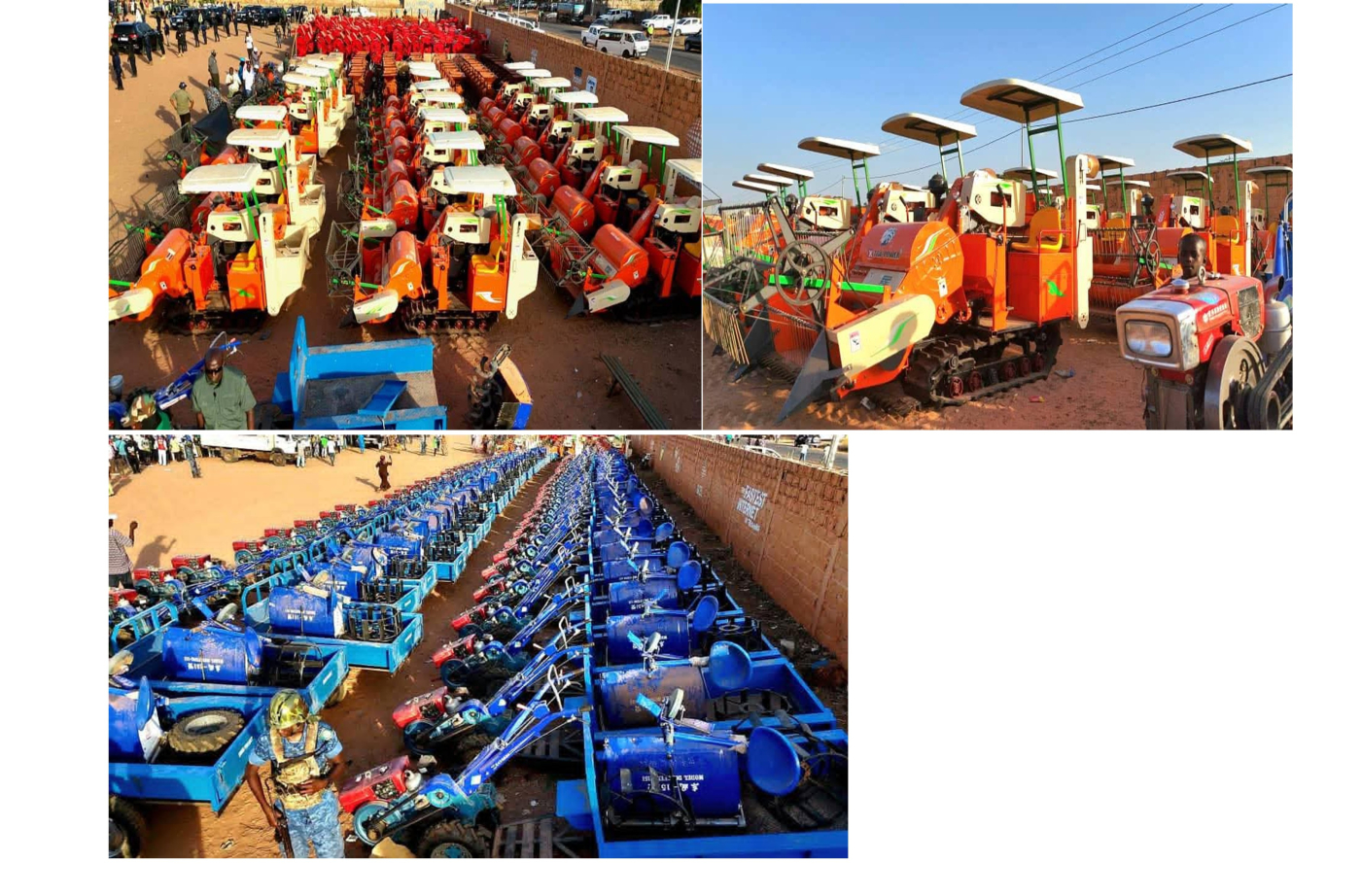
The distribution formed part of President Barrow’s ongoing six-day nationwide tour, which also includes laying foundation stones for feeder roads to connect rural communities and ensuring that farmers have access to markets.
For decades, Gambian farmers have struggled with manual labour, limited mechanisation, and post-harvest losses that drained both productivity and morale. The new equipment, officials explained, is designed to ease the burden of farming, reduce waste, and encourage youth participation in agriculture. By mechanising land preparation, planting, harvesting, and processing, the government hopes to drastically increase yields and reduce the country’s dependence on imported rice.
Speaking at the distribution ceremony held in Brikamaba, President Barrow, said: “This event is not merely a symbolic gesture; it is a concrete demonstration of my government’s unwavering commitment to achieving national food security and self-sufficiency. At the core of our development agenda is the transformation of agriculture from subsistence-based production to a modern, resilient, and commercially viable sector, capable of feeding our nation and driving economic growth.”
The government, he said, recognises that mechanisation is indispensable to this transformation. “For too long, our farmers have relied on labour-intensive methods that limit productivity, constrain scale, and discourage youth participation. Through initiatives, such as GIRAV, we are deliberately investing in labour-saving technologies that reduce hard work, improve efficiency, and enhance output across the agricultural value chain.”
“The equipment being handed over today, comprising mini-combine harvesters, power tillers, rice threshers, maize shellers, and milling machines, represents a strategic shift towards modernised agriculture. These tools will not only ease the burden on our farmers but will also enable timely land preparation, planting, harvesting, and processing, thereby significantly increasing yields and overall productivity.”
“Equally important is our focus on reducing post-harvest losses, which have, over the years undermined food availability and farmer incomes. By investing in harvesting and processing technologies, my government is addressing inefficiencies that lead to waste and ensuring that more of what is produced reaches our markets and consumers. This is a critical pillar in our quest for food self-sufficiency.”
He added: “The GIRAV project continues to play a pivotal role in strengthening our agricultural systems through the promotion of climate-smart technologies, improved seed systems, and digital advisory services. These interventions are aligned with our broader national strategy to build a resilient agricultural sector capable of withstanding external shocks and ensuring sustainable food production.”
Mamour Alieu Jagne, Project Coordinator at CPCU, said the president has tasked the Ministry of Agriculture with leading the country toward food self-sufficiency. “By all measures, we are making progress. Mechanisation is one of our key issues, and today’s event is a testament to government efforts to address farmers’ challenges and make mechanisation easier,” he said.
Jagne explained that mechanisation improves production and creates jobs, as operators are needed for harvesters and power tillers, as well as technicians for repairs. He urged farmers to ensure proper use and management of the equipment to guarantee sustainability, stressing that constant replacement would hinder investment in other areas.
“Those who receive this support should consider it a privilege and handle it properly. We are here to work with farmers to achieve the president’s objective of national food self-sufficiency,” he added.
Regional Governor Ousman Bah said it is the first time such materials have been provided in the country. He highlighted that the GIRAV project alone has constructed 13 smart farms in the region, alongside other agricultural projects and matching grants.
He noted that women have benefitted from seed supplies, increasing their production and earnings, with some even able to purchase compounds from their profits. He explained that over the past five years, the region has received significant farm implements geared toward supporting farmers, describing it as the first of its kind and noting that it has boosted farming activity.
He urged beneficiaries to protect the equipment so it lasts, adding that while not all farmers can access it immediately, the government’s aim is to ensure that every farmer has the necessary tools to till the soil and contribute to food self-sufficiency.
Malang Ceesay, the Alkalo of Brikamaba village, said the government is on the right track with the provision of those materials. He added that the country cannot achieve food self-sufficiency without modern farm implements to till the soil.
The Chief of Lower Fulladou West District, Momodou Lamin Baldeh, hailed President Barrow for the rapid development across all regions, especially CRR. He said with this equipment, CRR - being the food basket of the country - will be on the right track to attaining food self-sufficiency.
Isatou Ceesay, representing poultry farmers, said farmers are no longer facing difficulties in accessing farm implements due to the government’s relentless effort in supporting farmers nationwide. She noted that women are now venturing into agriculture and poultry, as the work has become less arduous thanks to the government’s provision of farm implements.
Alhagie Ceesay, Farmers’ Union representative, explained that the tour is aimed at ensuring farmers have access to their farms and markets. He added that previously only Brikamaba, Jarreng, Jahally, and a few villages had electricity, but now many communities have been connected through electrification expansion projects.
National Assembly Member Gibbi Mballow said most of the materials people once saw only on the internet are now available in the country. He noted that the president has introduced rice cultivation machines that reduce the heavy labour women used to endure. He added that the Brikamaba community has urged the president to provide street lights, expand water supply, and improve roads from Fullabantang to the rice fields and the Sinchu Dembel road, expressing optimism that these roads will be constructed.