This mega facility at Chaoyang District remains the first literary museum of the People's Republic of China and doubles as the largest literary museum in the world, holding a whopping collection of about 980,400 items.
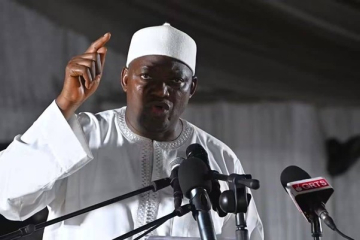
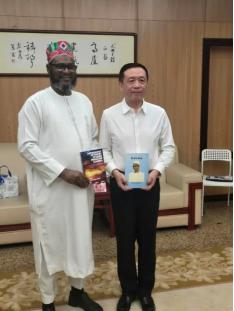
Professor Barry, who did the presentation on August 17, was warmly received by Mr Zhang Hongsen, chairman of the China Writers Association.
The museum's Deputy Director conferred the Collection Certificate to Prof. Barry, confirming that the volumes have entered the permanent collection rather than being received as informal gifts.
This comes as a historic milestone in the Writers' Association of The Gambia's endeavour to promote Gambian literature, especially at the international stage, as it marks the first structured presentation of Gambian literature to a Chinese national literary institution.
Professor Barry highlighted and lauded the fact that Gambian books would now be "held in the same institution that preserves the manuscripts of Ba Jin, Bing Xin and Ding Ling".
"That matters less as an honour than as a precedent. It tells us that Gambian writing can be catalogued, researched and read far beyond our borders, and it tells us what we still have to build at home," he said.
Professor Barry said every year, a lot of Gambian literary materials that can never be replaced are lost, underscoring that a national literature is not only what is written but what is kept.
With the visit being part of a study mission, the WAG now intends to localise what has been seen in China in terms of literary preservation, beginning with a digital Gambian Writers' Archive to gather manuscripts, correspondences, photographs, recordings and first editions while they remain recoverable.
Discussions with the China Writers' Association delved into a Gambia-China translation programme, reciprocal residencies, festivals and book fair participations, joint anthologies and technical cooperation on literary archiving, among others.
Meanwhile, the 53 books, which ranged from poetry, play, history, biography, to children's literature, language, folklore and others, were donated by prominent Gambian authors and a publishing establishment.
They included Dr Florence Mahoney, Patience Sonko-Godwin, Hassoum Ceesay, Nana Grey Johnson, Fodeh Baldeh (Fulladu Publishers), Dr Seedy Drammeh, Sukai Mbai Bojang, Juka Fatu Jabang, Momodou Ndow, Aisha Jawara, Global Hands Publishing, and Prof. Barry.