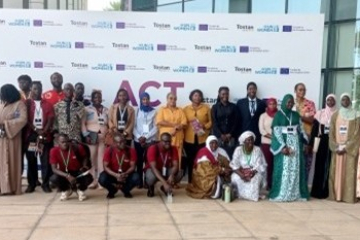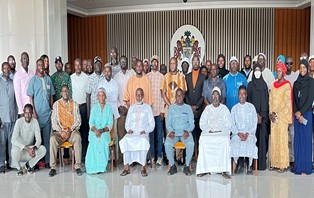
The programme seeks to enhance institutional and technical capacities for the effective development and implementation of the REDD+ framework in The Gambia. It is part of a broader sub-regional initiative involving five West African countries: The Gambia, Sierra Leone, Benin, Guinea-Bissau and Guinea (Conakry).
Speaking on behalf of the Deputy Director of Forestry, the Head of the Participatory Forest Management Unit, Alieu Barry, said The Gambia’s forest landscape has undergone significant degradation over the past decades, driven largely by agricultural expansion, population growth and rising demand for land to meet food security needs.
“In response to these challenges, The Gambia has demonstrated strong political will to address climate change and environmental degradation,” Mr Barry said. He noted that in line with Article 5 of the Paris Agreement, the country is actively engaged in the REDD+ mechanism, which promotes the reduction of emissions from deforestation and forest degradation while supporting conservation, sustainable forest management and enhancement of forest carbon stocks.
He described REDD+ as a major opportunity for developing countries to access results-based climate finance while protecting forest ecosystems and advancing sustainable development. He emphasised that effective participation in REDD+ requires careful preparation through a coordinated and inclusive readiness process, making the development of a National REDD+ Roadmap both timely and strategic.
“The Roadmap provides a clear framework to align national forest and climate initiatives with international best practices and to maximize benefits for the country,” he said.
Also addressing the gathering, Climate Finance Adviser at the Ministry of Finance and Economic Affairs (MoFEA), Bubu Pateh Jallow, explained the importance of forests in absorbing carbon dioxide and regulating emissions. He noted that while The Gambia’s forests were once a major carbon sink in the 1980s, they later became a net source of emissions due to accelerated deforestation.
“We must remedy this situation and bring our forests back to being carbon sinks,” Mr Jallow said, adding that REDD+ also considers emissions from agriculture, which has recently overtaken forestry as the country’s highest emitting sector. He stressed that implementing REDD+ seriously would not only reduce emissions but also attract significant climate finance to support national economic development.
“This is not only about reducing emissions; it is about putting our economy on a sustainable development path,” he added.
Representing the Permanent Secretary at the Ministry of Environment, Climate Change and Natural Resources, Principal Planner Ibrahim Colley highlighted alarming trends in forest loss. He recalled that forest inventories from the 1970s and early 1980s showed that about 40 percent of the country was under forest cover. However, surveys between 1997 and 2010 revealed that nearly 100,000 hectares of forest had been lost, representing an annual degradation rate of about 8,000 hectares.
He attributed this decline to factors such as agricultural expansion, population growth, settlement, illegal logging, unregulated extraction of forest resources and land disputes.
Mr Colley emphasised that protecting forests should be viewed not as a cost to development, but as an investment in the country’s future. He said the validation of the REDD+ Readiness Roadmap would boost government and investor confidence by ensuring transparency, accountability and credible climate action.
“Forests are not just carbon sinks; they are homes, cultures, sources of resilience and engines of sustainable development,” he said, stressing the central role of indigenous peoples and local communities in sustainable forest stewardship. He described the validation as a call to action, marking the beginning of scaled-up ambition, resource mobilisation and stronger cross-sector partnerships.
For her part, Assistant FAO Representative in charge of Programmes, Dr Mustapha Ceesay, described the validation workshop as a key milestone in The Gambia’s REDD+ consultation process. He commended the government, particularly the Ministry of Environment, Climate Change and Natural Resources and the Department of Forestry, for demonstrating strong leadership in advancing the REDD+ agenda.
He said the REDD+ Roadmap is a strategic instrument that supports climate change mitigation while strengthening sustainable forest management, biodiversity conservation and livelihoods, and aligns well with The Gambia’s Nationally Determined Contributions (NDCs).
Dr Ceesay explained that the roadmap is the result of an extensive and inclusive national consultation process led by a national consultant in close collaboration with the REDD+ National Coordination Group.
Consultations were conducted over six days across all regions of the country, engaging stakeholders to identify drivers of deforestation and validate actions under the four key REDD+ pillars: national strategy, forest reference levels, national forest monitoring systems, and safeguards to information systems.