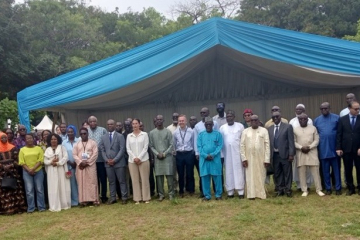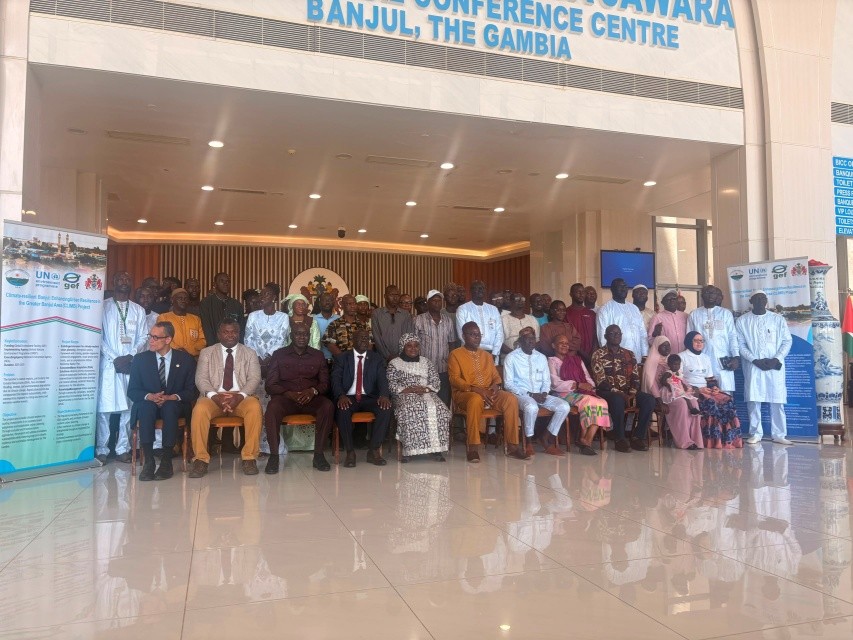
Valued at over $12 million and funded by the GEF through UNEP, the CLIMB Project is the first large‑scale urban climate resilience initiative of its kind to be implemented in Africa. It aims to strengthen governance and urban planning, safeguard wetlands and mangroves through ecosystem‑based adaptation, and empower communities with knowledge and early warning systems to withstand climate shocks.
Speaking at the launch, Vice President Jallow reaffirmed government’s commitment to building a climate‑resilient future for The Gambia. He noted that the project will not only protect vulnerable ecosystems but also enhance the capacity of urban communities to adapt to the growing threats posed by climate change.
The initiative is expected to serve as a model for other African nations, demonstrating how integrated urban planning and community‑driven adaptation can mitigate climate impacts while promoting sustainable development.
Environment Minister Hon. Rohey John Manjang hailed the launch as a landmark step in the nation’s fight against climate change. She underscored the urgency of addressing climate risks in the Greater Banjul Area, citing rapid urbanisation, pressure on wetlands and mangroves, and rising temperatures.
“Temperatures in The Gambia have increased by approximately one degree Celsius since the 1960s. Rainfall patterns are increasingly erratic, contributing to severe flooding. Coastal erosion continues to threaten our coastlines, with recession rates reaching up to two metres per year in some areas,” she said.
The Minister stressed that the CLIMB Project aligns with The Gambia’s long‑term climate strategy and commitment to sustainable development, strengthening environmental governance, coastal protection, urban planning and energy‑based solutions.
National Environment Agency (NEA) Executive Director Dr. Dawda Badjie highlighted the urgency of tackling flooding, erosion and environmental degradation in the Greater Banjul Area, worsened by rapid urbanisation and rising sea levels. “This project is about building urban climate resilience through ecosystem‑based adaptation and sustainable urban planning,” he said.
The project, which began in 2021, is supported by GEF and implemented with UNEP and partners. It represents the first of its kind in Africa under GEF’s support, positioning The Gambia as a model for climate adaptation on the continent.
Badjie emphasised the importance of national ownership, stakeholder engagement and institutional capacity building. “Projects come and go, but we must sustain them over time. If everyone plays their part, this initiative will succeed,” he noted.
He also underscored GEF’s role in supporting biodiversity, land restoration, climate adaptation and waste management in The Gambia for over three decades. By leveraging GEF resources alongside other funding mechanisms such as the Green Climate Fund and Adaptation Fund, the project seeks to maximise impact through synergy rather than fragmented efforts.
United Nations Resident Coordinator Karl Paul Fredric stressed the urgent need for climate resilience, noting that The Gambia is among the nations most exposed to climate risks due to its geography, economy and settlement patterns.
“We have seen how devastating floods can be here and in other parts of the world. Coastal erosion continues to threaten communities, infrastructure, health and economic activities,” he said, adding that vulnerable groups such as women, youth, children and marginalised households bear the greatest burden of climate impacts.
Fredric emphasised that resilience is not built by responding to disasters alone but through planning, investment, policymaking and empowering communities to become active agents of change. The CLIMB Project adopts a whole‑of‑society approach, bringing together government institutions, local authorities, civil society and the private sector to strengthen climate resilience across the Greater Banjul Area.