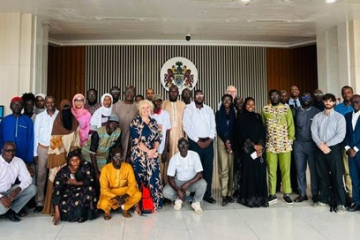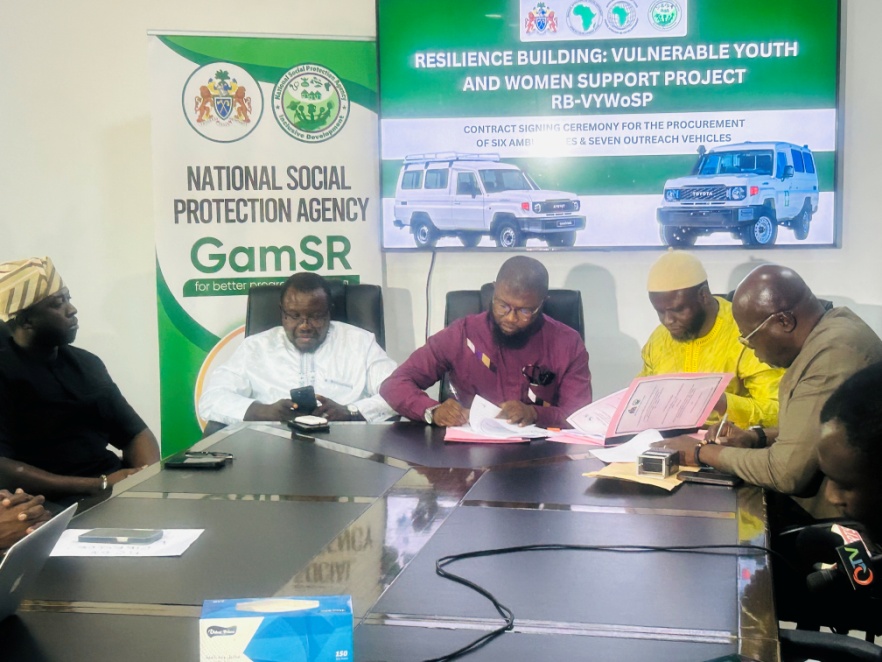
The signing ceremony took place on Friday 17 April 2026 at the Social Protection Office in Bijilo. The procurement is funded under the $20 million Resilience Building for Vulnerable Youth and Women Support Project, a joint initiative between the government and the AfDB. The financing agreement was signed in August 2025. Component Two of the project, which focuses on strengthening access to basic health services, is covering the cost.
Gango Motors was awarded the contract to supply six Toyota Land Cruiser ambulances at a total value of $324,000. TK Motors will deliver seven outreach vehicles for $32,435,160. Both contracts are duty-free, and suppliers are required to deliver within 20 weeks from signing. Officials confirmed the procurement followed African Development Bank standard procedures through open international competitive bidding.
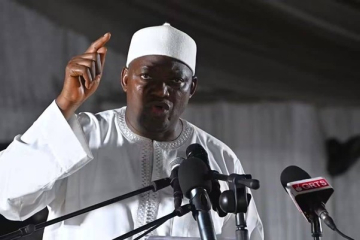
Speaking at the event, the Executive Director of the National Social Protection Agency Saikou Jeng said the intervention goes beyond vehicles. “This represents a strategic investment in human capital development, which is the core of sustainable national growth,” he said. He noted that access to healthcare is an integral part of social protection, and the new fleet will help ensure services reach women, children, persons with disabilities, and people in remote areas.
The Permanent Secretary at the Ministry of Health Lamin Dampha described the signing as a “very joyful moment” for the ministry. “Our vision is that every Gambian, wherever you live, must have access to healthcare. And not only healthcare but quality healthcare,” he said. He added that the ministry wants to end the practice of women being transported by donkey carts or horse carts, and to ensure pregnant women are not at risk from wild animals while traveling to facilities at night. “We want them to be safe and to access care easily, any time of day or night.”
He explained that the outreach vehicles will allow health experts to take services directly to communities without permanent health facilities.
Distribution of the vehicles will prioritise underserved regions. Two ambulances will go to Bwiam General Hospital, with one each allocated to health centers in Kuntaur, Janjanbureh, Farafenni, and Yorobawol. The outreach vehicles follow a similar plan: two for Bwiam, and one each for Kuntaur, Fatoto, Janjanbureh, Farafenni, and Yorobawol.
He added: “This is not the first delivery under the partnership. Two ambulances were handed over to the Ministry of Health in an earlier phase and are already operational.” The same project also supported the renovation of the Tanka Tanka Mental Health Center and the Bundung Maternal Center. More health center renovations are planned across the country.”
Project coordinator Mr Safie Dambelleh stressed that success will depend on proper use, maintenance, and accountability. “This is not just the end of the process, but rather the beginning of a renewed commitment to service delivery and impact,” the NSPA Executive Director said.
The permanent secretary from the Ministry of Health used the occasion to call for continued collaboration and additional funding, noting that while many ambulances have been purchased recently, more are still needed so every community can access emergency care. Delivery of all 13 vehicles is expected before the end of August 2026.