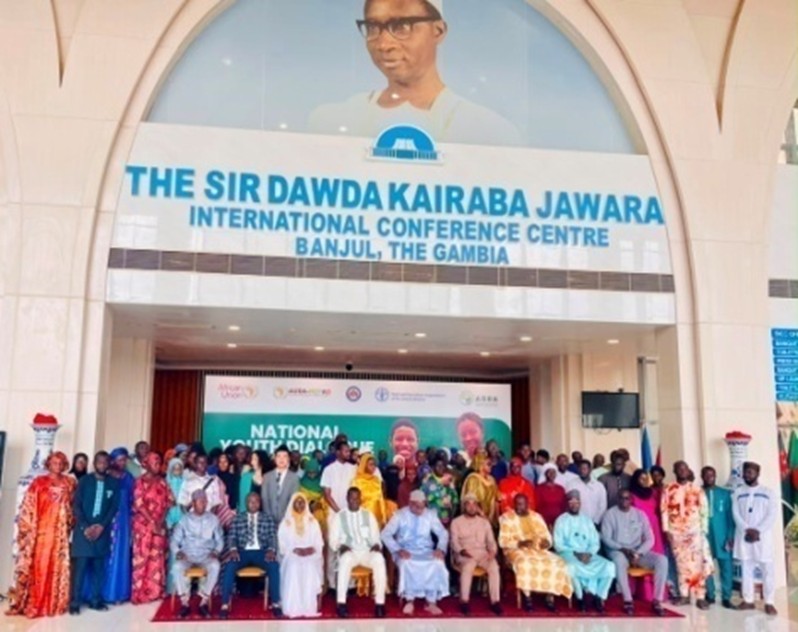
The two-day Joint Youth-Parliamentary Retreat on Youth, Agrifood Systems Transformation and CAADP Implementation, held at the Sir Dawda Kairaba Jawara International Conference Centre under the theme "National Leadership for Youth in Agrifood Systems", brought together policymakers and youth leaders to develop practical solutions for strengthening youth participation in agriculture.
The retreat, organised by The Soil Solution in collaboration with the Ministries of Youth and Sports and Agriculture, AGRA and other partners, seeks to produce practical recommendations that will strengthen youth participation in agriculture and support implementation of the Comprehensive Africa Agriculture Development Programme (CAADP).
Speaking at the retreat, Vice President Muhammed B.S. Jallow said agriculture must evolve from subsistence farming into a modern, technology-driven and profitable industry capable of creating jobs and attracting young people.
He described youth empowerment in agriculture as a national development imperative, saying the country's youthful population represents its greatest asset.
"The answer lies not only in creating jobs but in transforming entire economic sectors that can generate sustainable livelihoods, wealth and prosperity," the Vice President said, urging parliament, government institutions, development partners and the private sector to work together to create opportunities for young people.
However, beyond the official speeches, participants repeatedly highlighted the practical obstacles preventing young Gambians from entering and expanding in agriculture.
Speaking on behalf of young participants, Mariama Sonko said young people are already leading innovations in agribusiness, climate-smart agriculture and digital technologies, but continue to struggle with limited access to land, finance, markets, technology and skills.
She said the retreat provides an opportunity for young people to influence policies instead of remaining mere beneficiaries of development programs.
"The success of this retreat will not be measured simply by the discussions that we have, but by the partnerships that we strengthen, the commitments we make and the actions we take after we leave this room," she said.
Executive Director of the National Youth Council, Alagie Jarju, urged lawmakers to ensure concerns raised during the retreat are translated into legislation and government action.
Jarju identified access to land, high lending rates, expensive production costs and limited markets as some of the biggest challenges facing young farmers.
He criticised commercial bank interest rates of more than 20 percent, warning that they make farming economically unsustainable.
"I tell every young farmer, taking a bank loan with a 24 percent interest rate is suicidal. You're just working for the bank," he said, calling for single-digit lending rates and increased government support.
Jarju also challenged the long-held perception that agriculture is only for older people or merely a means of producing food for household consumption.
"Agriculture is a whole business and a whole value chain," he said, adding that young producers also need support with value addition, packaging and marketing to compete with imported products.
Representing the African Food Systems Parliamentary Network (AFSPaN), Hon. Bamenju Agho said African countries must move beyond continental declarations to practical implementation.
He cited the African Union's latest Biennial Review Report, which found that while progress has been made, no African country remains on track to achieve the Malabo Declaration commitment of ending hunger.
He argued that parliaments have a crucial role in modernising legislation, strengthening budget oversight and creating policies that remove barriers facing young agripreneurs.
"Youth are no longer treated as a constituency to support politically; you are recognised as partners in transforming Africa's agrifood systems," he said.
Hon. Sulayman Jammeh, Chairperson of the Select Committee on Regional Government, Lands, Ombudsman and IEC,reaffirmed Parliament's commitment to supporting policies that empower young people across agricultural value chains.
He said members of parliament must create an enabling legislative environment, strengthen oversight and ensure adequate budget allocations for youth-inclusive agricultural development.