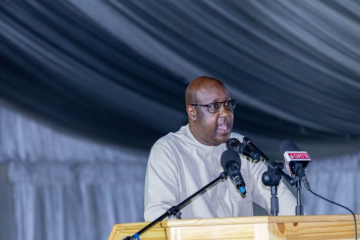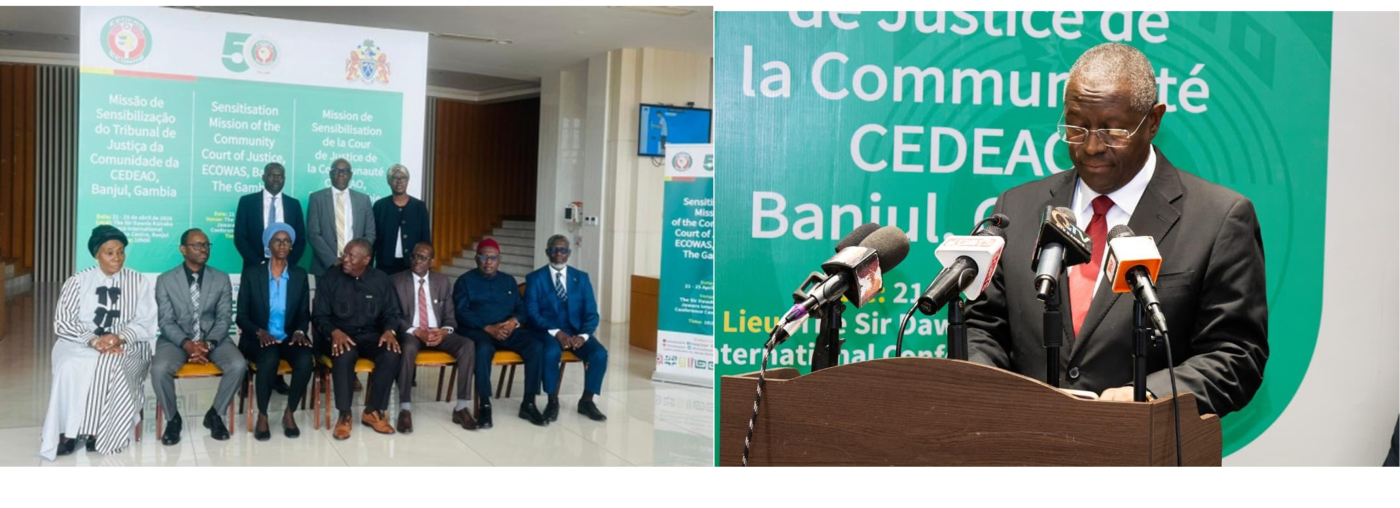
Hon. Justice Monteiro told the lawyers and law students stated that the ECOWAS Court of Justice belongs to them as much as it belongs to the peoples of West Africa.
“Its success depends on the quality of your engagement, your expertise, and your commitment to the rule of law. In The Gambia, where significant progress has been made in strengthening democratic institutions and advancing fundamental freedoms, the role of lawyers is absolutely central. It is lawyers who, in their daily work, give life to the principles of justice, legality, and human dignity—ensuring that rights enshrined in law are translated into tangible realities for citizens,” he told the participants.
Hon. Justice Monteiro further informed the Gambian legal community that by mastering the Court’s procedures, deepening their knowledge of its jurisprudence, and embracing its digital transformation, they contribute decisively to ensuring that regional justice is no longer an abstraction, but a concrete and accessible reality.
He also implored them to unite and build a vibrant legal community - comprising lawyers and academics - that recognises in the ECOWAS Court not a distant institution, but an essential partner in the Community’s shared mission to protect human rights, strengthen regional integration, and promote the rule of law.
Hon. Justice Monteiro praised the Gambia Bar Association for being instrumental in defending human rights, promoting democracy, and consolidating the rule of law in the country.
He said their work, often undertaken in challenging circumstances, has strengthened public confidence in institutions and ensured that justice remains accessible, independent, and effective.
“The ECOWAS Court has developed a significant body of case law in areas such as fundamental rights, due process, access to justice, and State responsibility. These decisions not only clarify the scope of Community law but also increasingly influence national legal systems. For lawyers, knowledge of precedent is indispensable for strong and persuasive advocacy. For students, it offers an entry point into the dynamic reality of regional integration law,” he stated.
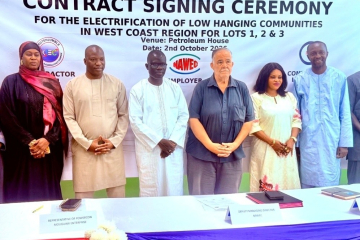
ECOWAS on Wednesday launched a three-day sensitisation mission in The Gambia on the mandate, jurisdiction, practice, and procedures of its Community Court of Justice in The Gambia.
Established under the Revised ECOWAS Treaty and its subsequent protocols, the Court serves as the judicial organ of the Community, ensuring the interpretation and application of Community law and the protection of citizens’ rights at the regional level.
The ECOWAS Community Court of Justice’s human rights jurisdiction has emerged as a cornerstone of regional accountability and as a beacon of hope for victims of violations. The Court’s jurisprudence has contributed to consolidating regional protection standards and strengthening citizens’ trust in supranational justice.
For Neneh M.C. Cham, President of the Gambia Bar Association, the session would give legal practitioners, law students, and lecturers, an overview of the Community Court's mandate, jurisdiction, processes and procedures, demonstrating how the Court bridges the gaps in the local justice system in instances where local remedies are either inadequate, ineffective or unavailable.
The GBA President believes that the knowledge gained would in turn empower the private legal practitioners to hold the State accountable and State Law Officers to confidently defend cases against the State.
“The session will begin to equip us to give well-grounded advice and guidance on how to appear and give effective representation to victims of human rights violations and parties to treaty disputes before the Court. Engaging the Court strengthens the regional accountability mechanism and reinforces the court's role in upholding democratic governance and human rights,” she said.
Counsel Cham also stated that the session will allow them to gain clarity on the Court's four mandates: community law and its interpretation, administrative disputes, Human rights, and Arbitration.
She said the ECOWAS Court provides direct access to regional justice, giving citizens of its member States and corporate bodies direct access to it, enhancing the rule of law and accountability especially for alleged human rights violations.
“It is worth noting that Gambian victims of human rights violations have since the expansion of the court's mandate, engaged the court on several occasions, obtaining landmark judgments. These cases include Musa Saidykhan v The Gambia and Chief Manneh v The Gambia to name a few, thereby building a rich jurisprudence of the Court,” she cited.
Meanwhile, the Dean of the Law Faculty of the University of The Gambia praised ECOWAS for organising such a forum for lawyers and law students.