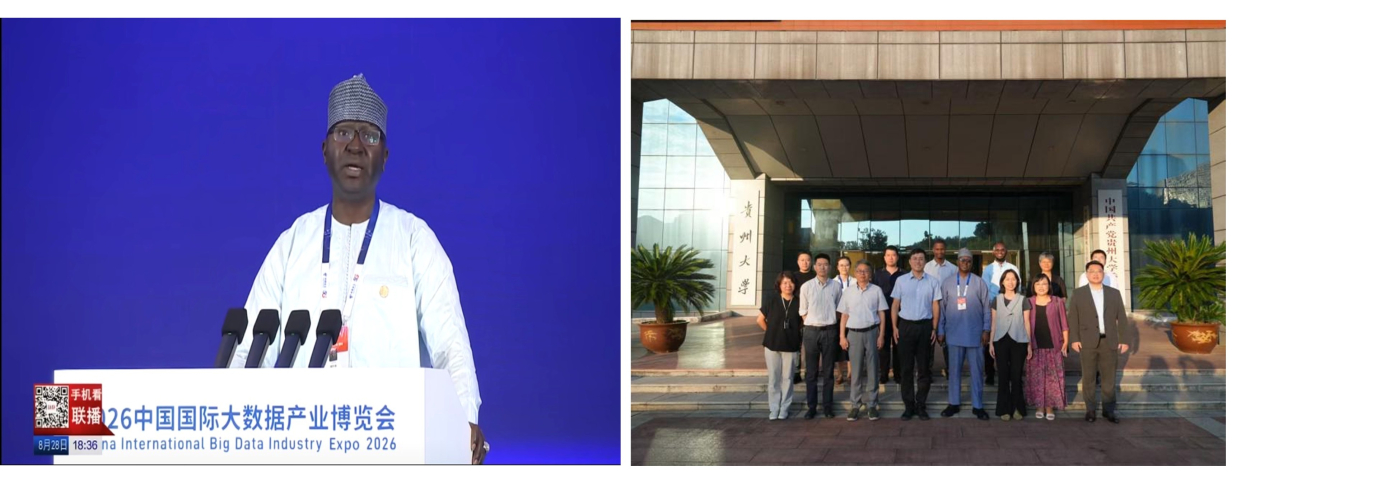
Ambassador Kah, who is Former Chair and current Vice-Chair of the UN Commission on Science and Technology for Development (CSTD) and Vice-Chair of the UN CSTD Working Group on Data Governance, addressed an audience of world leaders, parliamentarians and more than 350 global enterprises, alongside dignitaries including Secretary Xu Lin and Pakistan’s Hon. Chief Minister Maryam Nawaz Sharif.
Speaking under the theme “Data Creates More Value, Innovation Brings a Better Future,” the Gambian diplomat posed what he called the defining question of the intelligent age: not whether data will create value, but “value for whom?” With Africa set to hold one in four of the world’s working-age people by 2050, he declared that the Global South “refuses to be an exporter of raw data and an importer of finished intelligence,” calling for partnerships in which developing nations “co-design, co-architect, co-innovate and co-own” — so that a young innovator in Banjul stands shoulder to shoulder with her peers in Guiyang or Shenzhen.
He urged action on three priorities: open and inclusive international cooperation; trusted and balanced global data governance that protects privacy and digital sovereignty; and deeper South-South partnerships that enable developing countries to leapfrog by learning from digital pioneers such as Guizhou, China’s first national big data pilot zone.
In the afternoon, Ambassador Kah opened the “Public Big Data” Exchange Event, describing public data as “a strategic national endowment and a vital Digital Public Good” that can accelerate the Sustainable Development Goals — from public health and disaster resilience to smart cities, education and food security. For Africa and the Least Developed Countries, he said, public data is “our most democratic path into the intelligent age.”
The following day, 29 August, Ambassador Kah led a delegation on an official visit to Guizhou University, where he was received by Vice President Wang Xu and toured the Guizhou Provincial Big Data Laboratory. The visit celebrated seven years of cooperation between Guizhou University and the University of The Gambia, which jointly established a Confucius Institute in 2019 — a partnership Vice President Wang described as a vivid embodiment of China–Gambia educational exchange, noting Gambian students currently pursuing advanced studies at the university.
Ambassador Kah, a former President (Vice-Chancellor) of the University of The Gambia, said the visit felt like “coming home,” and announced four cooperation initiatives: positioning the Guizhou Provincial Big Data Laboratory as a data governance research centre for the UN CSTD; establishing a national data laboratory in The Gambia that replicates the Guizhou experience; creating scholarships in big data and AI governance for the Global South; and convening a joint Gambia–Guizhou summer school on big data and AI. He also invited Guizhou University researchers to contribute to the report of the UN Working Group on Data Governance, lending a voice to the Global South.
“The Gambia is a small nation with great determination — an ideal partner for demonstration-scale cooperation,” Ambassador Kah told his hosts.
Closing his keynote before the international gathering, the Ambassador declared: “May the Big Data Expo remind the world that data, wisely and inclusively governed, is humanity’s most shareable resource — and that our digital future will be truly intelligent only when it is truly shared, leaving no one and no country behind.