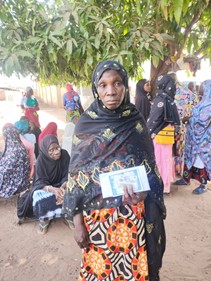
Speaking to The Point during the January cash transfer at Fantumbung village in Kantora district, Upper River Region, where fifty-nine beneficiaries received payments, Bana Sanyang said the project had transformed her household. She explained that the funds she receives every two months have enabled her to venture into petty trading and animal husbandry.
“I am grateful for the Nafa programme, but I urge the government and the World Bank to expand it by introducing projects designed specifically for women. Such initiatives would boost our income generation and help us better support our families,” she said.
At the same pay point, Mamadu S. Bah, Nutrition Field Officer for the Upper River Region, noted that 95% of beneficiaries are women, most of whom have expressed the need for projects tailored to their empowerment.
“The Nafa programme has helped countless households across the regions. Many women see it not only as a source of income but also as vital support for themselves and their children. A new project designed entirely for women would further improve their living conditions,” Bah explained.
Another beneficiary, Makujeh Sahano, from Misiraba Mariama in Kantora district, praised the programme for enabling her to expand her business. “With the Nafa cash transfers, I can now exchange dalasis for CFA, travel to Senegal, buy goods, and resell them back home,” she said.
The Nafa project is implemented by the National Nutrition Agency (NaNA), the Department of Community Development (DCD), and the Directorate of Social Welfare (DSW). Jointly funded by the World Bank and the Gambian government, the programme aims to provide a foundation for sustainable livelihoods for the poor and vulnerable.
It forms a sub-component of the RISE project, which targets the 20 poorest districts in The Gambia. Three districts have already graduated, while the programme has expanded to an additional sixteen rural districts nationwide. More than 15,000 households are currently benefitting from bi-monthly cash transfers and Social and Behavioural Change Communication (SBCC) sessions.