It was a shock.
Walking carefully from Baobolong Riverside, torch in hand to avoid the stones, potholes and culverts that locals know so well, I made my way along the breezy, dusty environs of Janjanbureh toward the Festival site near the sacred Baobab Tree, adjacent to the Museum. This would be my fifth visit to the event and images of those former events were firmly fixed in my head. A crowded audience of Gambians ringed around a dusty performance area, one covered tent housing a hundred or so VIP's, a lot of noise, a TV camera crew and some very annoying Tubabs who assumed it was their right to stroll in front of the performers and point their cameras in the their faces. With those expectations in mind I followed the emerging glow.
How wrong was I
The 2026 Janjanbureh Kankurang Festival was a sight, and a site to behold. The square arena was surrounded on three sides of a square with multiple canopy topped marquees glinting white in the floodlights situated on all corners, hundreds of seats perfectly set in each one. The main stage, elevated in the fourth part of the square had been wired up, lit up, miked up, pedestalled up, logoed up, visible and audible. An extremely professional set-up. How this had been accomplished by Friday, having been a dust bowl on Wednesday was quite beyond me.
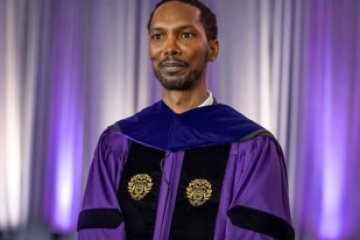
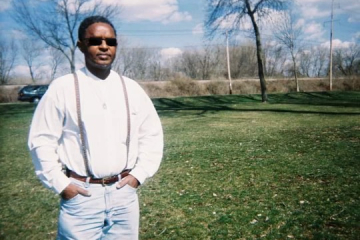
Standing, by chance, near the entry point where the performers congregate to ingress the stage, one of the charming ushers assumed that this Toubabo possessed a pre-booked seat, but no, I didn't even think there would be any pre-booked seats. How wrong was I. Among the audience were some who would shortly be up on stage announcing the events to come, the reasons for coming, and the origin of this particular occasion. A prime mover in that process was one Taka Titi, not actually from Janjanbureh, but a guiding force nonetheless. It was he who had been commissioned to make a Kankurang Statue for me but he passed just a couple of weeks later. I had no Idea what a unique person he was, no idea how revered he was, no idea that it was he who planted the seed of this festival. Our host announcer, Kebba Mbenga, and speaker, Siyaka Fadera (Minister of Tourism), enlightened everyone of Taka's unrivalled status. We all have heroes and he was clearly one to many people. When interviewed he would regularly accompany his responses by beating a set of drums in the appropriate percussive tempo. Most entertaining. A natural performer and visionary. One Minute's Silence. And for the Gambians I know, that is almost impossible.
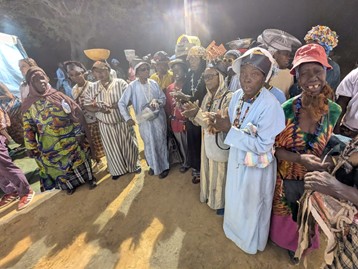
Janjanbureh Ladies Kafu Performers
First up was troupe of Ladies from the Janjanbureh Kafu. What a joyous, dignified, enthralling group they were. Being a somewhat timid sort I was, as mentioned lurking in the shadows near the entry point, so I got a better view than most. An elderly lady wearing a large ginger beard passed by, then a lady with an electric fan on her head breezed by, then a lady with a suitcase on her head, then a lady with a gap in her front teeth wider than the Grand Canyon, but a fabulous smile. In all about 25 ladies passed by rhythmically accompanied by an elderly gentleman with a drum and whistle. They put on a great show. I'm not sure what it was all about, but who cares.
Next a Jamba Kankurang, visiting from Kakai, leapt into the arena with stamping feet, wheeling arms, wielding flashing cutlasses. Speaking afterwards to the man inside the costume, Lamin Sow, he seemed happy with his performance, his fee and his tips.
On my walk back I happened to find myself surrounded by the Kafu Ladies still in performance mode. Rather than pointing a smart phone in their faces I gave them a few lines of my limited but best Mandinka and a crisp two hundred Dalasi note. I'm pretty sure, judging by the hoots of laughter, that one of them asked me for a date.
DAY TWO
Went for a hot, dusty, midday wander. Started at the Museum anticipating a quiet uninterrupted chat with Ebrima Barry (Secretary General, Event Management Committee). How wrong was I. The museum was very busy, many curious tourists and diaspora Gambians clustered around various ethnic entities including my Kankurang Statue, snaps of which have probably now reached every corner of the world. I spoke to James, from Scotland, who'd travelled down from Kartong with some Gambians he'd met there. Precisely the kind of outgoing intrepid visitors the Board of Tourism are attracting. Hopefully he, and others of a similar ilk, will return time and time again.
Ebrima sat me down in his office, disappeared with my pen, and said he'd be a couple of minutes. Half an hour later he limped back having fallen off a ladder attempting to repair a crucial piece of the event structure. 'Health & Safety' does not feature much in daily lives here. You do your work, take the knocks and electrocutions, and get on with things. I lent him my Deep Heat embrocation. He wrote down a list of EMC main players and returned my pen.
Well why not wander off and try to meet some of them, so I did. The grand entrance gates to the Governors complex were wide open and unattended. Adopting the pose of a hapless lost Toubabo, quite easy for me, I wandered in. Strolling around the exterior late colonial corridors of power, there wasn't a soul in sight inside any of the offices. Disappointed not to get a 'Scoop' interview with the Governor I noticed a man in the distance beckoning me from across the expansive courtyard. Fearful of being reprimanded for trespassing I beckoned back effusively in the pose of the village idiot, also quite easy for me. It was the Deputy Governor, the honourable Mr Saine Mbye, a most accommodating man who seemed happy to be photographed beside the ceremonial canon. He explained that he had some things to attend to so I thanked him, departed and realised I hadn't asked him a single probing question. Scoop!
The sound of distant drums suggested there was something occurring by 'The Freedom Tree'. As they grew louder I entered the triangular garden in which The Tree also grew. Musa Foon, the maker of the Kankurang Statue was guiding a few visitors around, so sitting on a very wobbly bench I waited for him to spot me. Shortly after he approached and greeted me warmly. Very speculatively I asked if there was any chance of meeting the EU Funding Manager. He took his mobile from his pocket, tapped in a number...
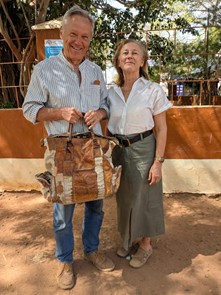 Enrica Pellacini (EU Funding Manager) Tim Lee (reporter)
"Enrica, hello, Musa, someone wants to meet you"
"She'll be here in two minutes," he assured me.
Surely enough, Enrica Pellacini turned up having just purchased a number of items from a nearby craft market and chatted with me for thirty minutes. I cannot speak more highly of this engaging Italian lady, passionate in her endeavours to assist all kinds of worthy causes, including funding placements for the festival. It was fascinating to learn so much more than I thought I already knew about The Festival, Migration, Trafficking, Job Creation, Transport, Tourism, Refuse Collection and more. The funding, meticulously placed, has transformed the festival into a major attraction, generating an injection of money into the economy, and her participation in that process has been invaluable. It is a shame that Western Union, Yonna, and other money changing operators ran out of cash on Thursday night! Some cashless card carrying tourists even journeyed to the bank in Basse just to learn that the ATM was out of order. They weren't exactly delighted.
The Show went on as planned. All the traditional cultural figures performed from various provinces. All the spirits, The Kumpo, The Hunting, The Zimba, The Fairies, The Kankurangs and the drummers were there beating the audience into a frenzy. It didn't disappoint.
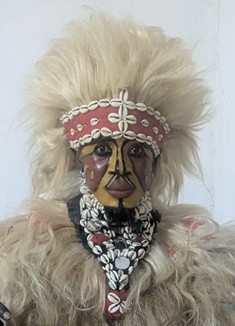
Lurking in the darkness once again near the 'Dressing Room' quarters I approached, my personal favourites, 'The Zimba Dancing Troupe', who appeared to be deep in their preparations for their performance. Surely this was my opportunity to 'scoop' an interview with 'King Zimba Leader' himself, the main man. Sidling up to this gloriously intimidating entity I adopted the pose of an investigative 'culture and arts feature writer' holding a 200 Dalasi note which he acknowledged with a silent thoughtful extension of his brightly bandaged fingers.
I greeted him. He gazed, well stared actually, back from his elaborately painted face in silence. I asked a probing question. SILENCE.
I retreated slowly guessing, perhaps wrongly, that his performance started as soon as his persona had been fully adorned. It was the shortest interview in history, but very memorable. Perhaps an interview with Daniel Day-Lewis preparing for the role of Harpo Marx or Marcel Marceau would have yielded similar results.
Yet 'The Zimba Leader' did indeed offer me the most beguiling 'photo op' of the night. A completely unobscured photograph of himself. SCOOP!
The Festival was almost over, everyone seemed happy, the only complaint I heard, and agreed with, was why some over-excitable female tourists seemed to think it was there God given right to invade the performance area, shove a smart phone in the face of the artist, make idiots of themselves, post it on Facebook and tell everyone 'Look what I just did'. There used to be a big policeman with a wooden stick patrolling the perimeters, perhaps they should bring him back. But very occasionally even one or two of the pitch invaders were actually quite funny.
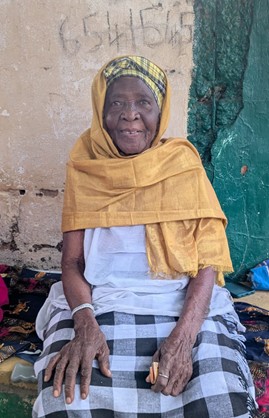
Aja Baboun Sidibeh
The last words MUST go to Mama Aja Baboun Sidibeh, at almost a hundred years of age, her memories stretch back and include what the real, true and genuine meaning of this 'Festival' is. She did not attend. She possesses the sole right to bless the Janjanbureh Kankurang, through her blood heritage, when she consents to placing her hand upon the head of the kneeling Island Kankurang prior to the 'real' programme which takes place over three months in the nearby forests. Her accounts are worthy of a biography rather than a few words in a newspaper. The real programmes where young boys are guided, disciplined, left to fend for themselves with time immemorial tasks, circumcised, and taught respect for their elders. A boundary is set around the sacred Baobab Tree and no female may trespass beyond it under pain of death. A fate that befell her very own 'stubborn sister' some seventy years ago. A casualty of the Kankurang's warning and his cutlass. So stage invaders had better beware! Perhaps the Tourist Board has been wise to reinvent the event as a 'Festival' rather than a 'Programme'. It is now a celebration of a cultural character collective. The Kankurang himself has become more of a party piece than the feared conveyor and guardian of timeless rites and traditions.
Perhaps the two worlds into which I have been so warmly invited can co-exist and accept each other's needs.