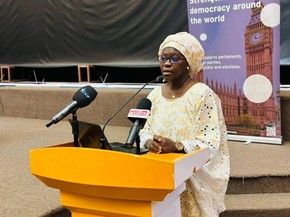
In a bold step to bridge the gender gap in The Gambia’s political leadership, the Westminster Foundation for Democracy (WFD), with support from the British High Commission in The Gambia, on Tuesday convened a high-level National Assembly simulation exercise aimed at preparing aspiring women candidates for parliamentary leadership.
Held at the Sir Dawda Kairaba Jawara International Conference Center in Bijilo, the landmark engagement brought together 83 participants, including 71 women and 12 men. Of the total, 45 were young people between the ages of 18 and 35, while two representatives of Persons with Disabilities (PWDs) ensured inclusivity in the exercise.
The initiative, themed “Women in Parliament,” recreated a parliamentary setting, offering aspiring women politicians practical exposure to legislative procedures, debate protocols, and the laws and regulations that guide parliamentary work. The exercise also created a rare platform for dialogue and mentorship between aspiring candidates and sitting female National Assembly Members (NAMs).
Delivering her welcoming statement, Tabu Njie Sarr described the exercise as a critical milestone in strengthening women’s political participation and leadership in The Gambia. She underscored that the simulation was designed to enhance participants’ understanding of parliamentary processes while building their confidence and readiness to contest future elections.
She said participants were drawn from political parties, civil society organisations, and women’s networks, ensuring inclusive representation of both party-affiliated and independent aspirants.
Central to the discussions was the Charter on the Rights and Dignity of Women and Girls, including Women with Disabilities. According to Sarr, the simulation provided a platform for dialogue on pressing social, political, and economic issues affecting women, with the aim of co-creating a resolution articulating collective support for the Charter and identifying priority demands to dismantle structural and socio-cultural barriers to women’s political participation.
She lamented the persistent underrepresentation of women in governance, noting that although women constitute more than half of the population and the majority of registered voters, they currently occupy only 3 of the 22 ministerial positions and 5 of the 58 seats in the National Assembly as of 2025.
Sarr further observed that political parties often serve as barriers to women’s advancement through discriminatory practices, limited financial backing, and exclusionary political environments. She added that weak coordination between elected female leaders and civil society actors continues to undermine collective advocacy efforts.
Despite these challenges, she expressed optimism that the simulation would help participants overcome fear and self-doubt, build leadership skills, and strengthen their resolve to increase women’s representation in the upcoming electoral cycle. She assured participants of WFD’s continued commitment to supporting women’s entry into parliament and other decision-making spaces.
In her keynote address, British High Commissioner Harriet King praised the aspiring women candidates for stepping forward to claim spaces historically dominated by men. She described their presence at the simulation as a testament to resilience, noting that many had overcome social pressure, financial constraints, political resistance, and cultural expectations.
The High Commissioner emphasised that the exercise was more than a practice session. “This is a rehearsal for real power,” she stated, saying participants would debate key national issues under the mentorship of sitting female NAMs and gain hands-on experience in parliamentary negotiation and policy articulation.
She stressed that women’s leadership would be crucial in the 2026–2027 electoral cycle, adding that The Gambia needs women’s clarity, empathy, lived experiences, and resilience in shaping national development.
Encouraging participants to persevere despite barriers, she remarked that when doors remain closed, women must push them open or build new ones for future generations. She reaffirmed the United Kingdom’s support for women’s political empowerment, concluding that when women rise, nations rise.
Also speaking at the opening, Deputy Clerk of the National Assembly, Buba Jatta, underscored the importance of ensuring that parliament reflects the demographic realities of the country. He pointed to Rwanda as an example of strong female representation, contrasting it with nations still struggling to achieve the minimum 30 percent quota for women in parliament.
Jatta stressed that women’s participation must go beyond numerical representation and translate into tangible, people-centred policies. He urged participants to actively engage in the simulation and support one another, observing that solidarity among women leaders is critical to achieving meaningful representation.
The simulation exercise marks a significant intervention ahead of the 2026-2027 elections, positioning aspiring women leaders to transition from observers to active lawmakers.
With women forming the majority of voters yet occupying only a fraction of leadership positions, the initiative signals growing momentum to transform The Gambia’s political landscape into one that is more inclusive, representative, and responsive to the needs of its people.
As participants left the conference hall, the message was clear: the path to equal representation may be steep, but a new generation of women leaders is preparing not just to enter parliament but to shape it.
The simulation exercise convened by the Westminster Foundation for Democracy (WFD), with support from the British High Commission in The Gambia, is more than a single event on the calendar of democratic reforms. It is a powerful reminder that democracy is not only about institutions; it is about inclusion, courage, and the deliberate creation of space for those historically left out.
Bringing aspiring women candidates into a simulated parliamentary chamber at the Sir Dawda Kairaba Jawara International Conference Centre sends a clear message: leadership is not reserved for a select few. It is learned, practised, strengthened, and claimed.
In a country where women form the majority of voters yet remain significantly underrepresented in decision-making spaces, such initiatives are both timely and transformative. The numbers alone tell a story of imbalance, but behind those statistics are countless capable women whose voices, experiences, and ideas have yet to shape national laws and policies. WFD’s intervention recognizes that representation does not happen by accident it requires preparation, mentorship, and structural support.
What stands out most is the intentional mentorship element. Creating dialogue between aspiring women and sitting female National Assembly Members bridges a gap that often isolates women in politics. It replaces competition with collaboration and transforms leadership into a shared journey rather than a solitary struggle. This is how sustainable change is built by strengthening confidence, networks, and collective vision.
The focus on the Charter on the Rights and Dignity of Women and Girls, including women with disabilities, also reflects a broader understanding of inclusion. True democracy cannot be selective. It must be intersectional. By ensuring youth participation and representation of Persons with Disabilities, the exercise reinforces the idea that governance must mirror the full diversity of society.
Beyond the technical understanding of parliamentary procedures, what this simulation truly cultivates is the belief that women belong in parliament, that they can debate with authority, negotiate policy, and influence national discourse. For many participants, this may have been the first time they envisioned themselves seated not as observers, but as lawmakers.
The work of WFD in The Gambia demonstrates that strengthening democracy goes beyond election-day support. It involves nurturing political culture, challenging discriminatory norms, and investing in the next generation of leaders. It means acknowledging that structural barriers exist and then actively working to dismantle them.
As the country approaches the 2026–2027 electoral cycle, initiatives like this may well prove pivotal. The journey towards gender-balanced representation is not easy. Social expectations, financial constraints, and party politics continue to limit women’s advancement. Yet every training, every simulation, every mentorship conversation chips away at those barriers.
When women are prepared, supported, and empowered to lead, the impact extends far beyond parliamentary seats. Policies become more inclusive. Debates become richer. Communities see themselves reflected in power. And democracy becomes more authentic.
This exercise is a glimpse of what is possible a future where young women step into leadership not with hesitation, but with confidence; not as tokens, but as transformative voices shaping The Gambia’s destiny.
If sustained and expanded, this work will not only change statistics. It will change stories. And perhaps most importantly, it will change expectations for this generation and the next.