The latest CepRass opinion poll, unveiled ahead of The Gambia’s December, 2026 presidential election, has landed like a firecracker in the opposition camp. Militants and sympathizers are dancing in the streets of social media, intoxicated by one dazzling headline number: ’49 per cent for the opposition’ versus ’34 per cent for President Adama Barrow and his NPP-led alliance’.
From this single figure, a bold prophecy has emerged indicating that any opposition candidate can now defeat Barrow.
Alas, this prophecy belongs more to the realm of political astrology than to serious arithmetic.
The celebrated 49 per cent is not the property of any one party or candidate. It is a political soup, an aggregate of all opposition tendencies stirred into one pot. Once we ladle it out properly, the menu looks far less appetizing. The UDP under Lawyer Ousainou Darbo accounts for about 20 per cent. Talib Bensouda’s UMC manages roughly 2 per cent. APRC (No to Alliance) contributes about 1 per cent. PDOIS and APP/Sobeya hover politely at around 1 per cent each.
The rest of this so-called “49 per cent” is made up of political tourists with 4 per cent saying they will not vote, 9 per cent undecided, and 3 per cent declining to answer, perhaps because they were tired of politics, or because they feared being recruited into a coalition by mistake.
So much for the illusion of a monolithic opposition wave.
For the opposition to outrun Barrow’s 34 per cent, all parties would have to perform a rare political miracle by uniting behind one candidate and successfully courting the undecided and the silent. Since those who will not vote are politically retired, they cannot be counted. If everything goes perfectly, no quarrels, no egos, no press conferences announcing withdrawals, the opposition might scrape together about 37 per cent. That would indeed be enough to beat Barrow’s present standing.
But politics is not a mathematics classroom but more like a family meeting with too many uncles and no chairperson.
Consider PDOIS. If it chooses to stand aloof, one percentage point vanishes immediately, leaving 36 per cent. Still possible. Now consider APRC (No to Alliance). Its approximately 1 per cent represents loyalists of former President Yahya Jammeh, whose chief political demand is his full pardon and triumphant return. Any opposition coalition that embraces that agenda would immediately disqualify itself from moral respectability. Excluding them reduces the opposition’s theoretical strength to 35 per cent, exactly where Barrow stands.
At that point, the “inevitable opposition victory” becomes a statistical tie, not a coronation.
Yet numbers are not the main battlefield. Politics is.
Any serious opposition alliance must be anchored on the UDP and led by Lawyer Ousainou Darbo, who controls the largest opposition bloc at 20 per cent. For the UDP, this is not a matter for debate. If it is not UDP-led and Darbo-fronted, it is not happening.
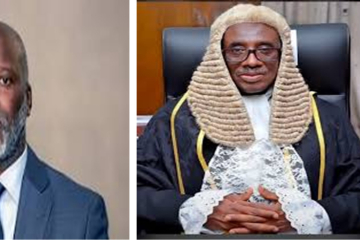
The real question, therefore, is whether the smaller parties are willing to swallow this reality. Early signs are not encouraging. Talib Bensouda’s UMC, though modest in polling strength, has already sent smoke signals of resistance. Recently, one of its loudest militants, Mr. M. C. Cham Jr., declared publicly that any coalition led by Darbo is doomed to lose against Barrow. Statements like that are rarely accidental; they are usually rehearsal speeches for party positions. Strikingly, no serious correction followed from the UMC leadership.
If UMC walks away, its 2 per cent walks with it. The opposition total drops to about 33 per cent, now below Barrow’s 34 per cent. The great “49 per cent advantage” evaporates like morning dew.
To proclaim Barrow’s defeat on the basis of this poll is therefore an act of intellectual carelessness. It is either wishful thinking or deliberate mischief. Ironically, the most mature response came from the UDP itself. The party welcomed the poll and calmly announced it would refine its strategy, citing Malawi and Zambia, where opposition victories occurred despite gloomy surveys. That is the language of political adults, not of premature victory parties.
However, beyond coalitions and calculators, the poll exposes a deeper unease. Barrow’s possible third term. While constitutionally legal, it is morally controversial. Fifty-eight per cent of respondents believe it would weaken democracy, and a clear majority want strict term limits.
Here lies the difference between legality and legitimacy. Barrow may win under the Constitution, and such a victory would be lawful. But governing a population that believes he has overstayed his welcome is a different enterprise altogether. Political authority rests not only on ballots but also on moral consent.
In short, the CepRass poll does not prove that “the opposition will win.” What it proves is that the race is open, that dissatisfaction with governance exists, and that unity is not optional to unseat the government but the oxygen to do so. Without a credible coalition anchored on the UDP and accepted by smaller parties, the famous 49 per cent remains a mirage, illustrating its impressiveness from a distance but useless up close.