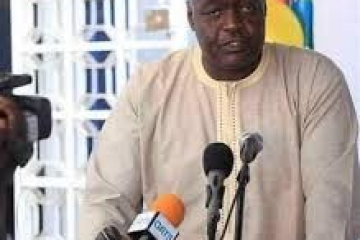
Former Commander of The Gambia National Army and Former Gambian Diplomat
In my appearance on Peter Gomez’s Coffee Time radio program last Thursday, I was asked who, among the contenders in The Gambia’s December 5, 2026 presidential election, I believed stood the best chance of winning. My answer was unequivocally President Adama Barrow.
Since then, I have been informed of allegations circulating on TikTok, reportedly promoted by certain opposition supporters, accusing my good friend, Government Spokesperson, Ebrima G. Sankareh, and me of participating in a clandestine financial arrangement. According to these allegations, President Barrow pays me D30,000 monthly, which Mr Sankareh allegedly collects and secretly delivers to me in exchange for my political support. The accusers have even challenged us to deny these claims publicly, specifically on the same radio program where I expressed my opinion.
Let me make my position unmistakably clear that these allegations are false. President Barrow has never paid me a clandestine monthly allowance of D30,000, D20,000, or even D200 through Mr Sankareh or any other government official in exchange for my support. Those making these accusations should produce credible evidence rather than attempt to manufacture a scandal around an honest political opinion.
My longstanding friendship with Mr Sankareh makes these allegations particularly offensive. I have known and worked with him for close to two decades, beginning during our years in exile in the United States, when I regularly contributed to his popular online newspaper, ‘The Gambia Echo’, alongside the late, erudite writer Matthew Jallow, may his soul rest in peace. Our fathers were also close, friends in their younger days, according to what his mother told me. Ebrima is, therefore, much more than an acquaintance; he is like family.
Those who portray him as a petty political fixer either do not know him or deliberately
misrepresent his character. He is an intelligent, forthright and principled individual. Furthermore, he has spent considerable time pursuing his doctoral studies in India over the past two years, a fact that makes the insinuations about his alleged monthly collection and delivery of money particularly questionable.
But let us move beyond personal attacks and address the substantive issue of why I support President Barrow.
My position is based on my assessment of his political strengths, communication skills and ability to connect with ordinary Gambians. I have yet to be persuaded that any other current contender would necessarily govern in a fundamentally different or more effective manner. More importantly, I believe Barrow possesses a political advantage that his critics frequently underestimate, particularly, his ability to communicate directly with the electorate in the languages they understand best.
Consider the presidency of Sir Dawda Kairaba Jawara. He was an exceptionally educated, articulate and internationally respected statesman whose command of English earned him considerable recognition, including a British knighthood. Yet his intellectual accomplishments alone did not keep the People's Progressive Party (PPP) in power for more than three decades. His electoral success depended substantially on political lieutenants who could translate the party's message into the language, idiom and everyday realities of ordinary Gambians.
The late Sanjally Bojang, former Vice President Saihou Sabally, Dr Momodou Manneh, the late Omar Jallow (OJ), the late Landinding Jallow Sonko and the late Buba Baldeh, among others, understood how to mobilize people through persuasive local-language campaigning. Their political value lay not merely in their official positions but in their ability to make the party's message accessible and compelling to voters. Jawara's political longevity cannot be understood without appreciating that contribution.
Yahya Jammeh subsequently demonstrated an equally important, and sometimes more direct, ability to communicate with voters in Mandinka and Wolof. His early emphasis on development, accountability and transparency also helped him cultivate support, whatever one's ultimate assessment of his record. His experience reinforced the fundamental lesson of Gambian politics that political communication is most effective when leaders speak in languages that resonate with their audiences.
President Barrow has taken this advantage further. His ability to address Mandinka, Fula and Wolof-speaking communities in their own languages enables him to connect directly with voters across significant sections of the electorate. In the appropriate setting, he can communicate with a familiarity and confidence that make people feel he understands their culture, concerns and aspirations.
This is not a trivial accomplishment but a formidable political asset.
Barrow does not always need an intermediary to interpret his message or persuade his audience. He can often do that himself. While some critics concentrate on his academic credentials, his political effectiveness rests on qualities that formal qualifications alone cannot provide. He is accessible, aware of his audience, can be personally engaged and has the instinct for communicating with ordinary people.
There is a useful parallel with US President Donald Trump. Trump has repeatedly demonstrated that political success does not depend exclusively on academic distinction or conventional elite approval. His direct, repetitive and audience-conscious communication has helped him mobilize a substantial electoral constituency. The comparison is not intended to equate their policies or records, but to illustrate how a leader's ability to reach voters directly can outweigh the criticisms of intellectual and political elites.
I believe Barrow understands this reality. If he remains his party's principal campaign communicator, continues engaging voters directly in their languages and presents a convincing account of his achievements and future plans, he can strengthen his electoral position considerably.
My support for President Barrow is a political judgment, not a commercial transaction. I am entitled to express it, just as his opponents are entitled to challenge it. What they are not entitled to do is invent payments and present them as facts without credible evidence.
Having assessed the field as it stands, I consider President Adama Barrow the most electable contender for December 5, 2026. I believe his command of local campaign languages, his direct connection with ordinary Gambians and his political instincts give him an advantage that his rivals do not have.
I support Barrow because I believe he is best positioned to win—not because anybody pays me to say so. Let the electorate decide on the basis of competing records, ideas and visions for The Gambia. That is the democratic contest we should be having.
Dissolution of the ECOWAS Mission in The Gambia contingent: End of a months-long operational commitment
This Wednesday, October 21, 2026, in Thiès, the disbandment of the contingent (9th Senegalese detachment) engaged in the mission of the Economic Community of West African States in The Gambia (MICEGA/ECOWAS - ECOMIG in English) took place. It was an opportunity for Colonel Mohamadou Abdoulaye Sylla, commander of military zone No. 7, to review the meaning of the ceremony, which marks the end of an operational commitment of several months, during which the men and women of DETSENS served with honor, discipline and dedication in a complex environment and in the service of peace and stability in The Gambia.
Colonel Sylla took stock of this commitment, paying tribute to the efforts made while expressing the recognition of the authority to all the personnel who contributed to the success of this mission. An ECOWAS mission in The Gambia that was deployed in January 2017 following the political and institutional crisis following the presidential election of 1 December 2016.
The senior officer recalled that this political crisis has put a brotherly and friendly country of Senegal in a political impasse with repercussions that could impact peace and stability in the sub-region beyond The Gambia. Faced with this situation, ECOWAS, with the support of the African Union and the United Nations, has undertaken several diplomatic initiatives to achieve a peaceful solution to the crisis and to ensure peace and security, which is a guarantee of stability.
Following the failure of the first attempts at mediation, ECOWAS decided to deploy a regional force to contribute to the restoration of constitutional order, to secure strategic points and to facilitate the effective assumption of office of the elected president and to pave the way for a political transition.
Initially designed to support this transition, MICEGA's mandate has been extended to contribute to the stabilization of the country, the strengthening of the capacity of the Gambian defense and security forces and the consolidation of democratic institutions. His presence is thus long-term, in the service of peace, security and stability in The Gambia.
It is in this context that the 9th Senegalese detachment, with 618 soldiers, including 10 female personnel, was deployed in The Gambia from September 21, 2025 to September 23, 2026. To accomplish its mission, DETSEN 9 was organized into several complementary units, located in different sites on the Gambian territory.
An organization based on complementarity and coordination of resources and which, according to Colonel Sylla, allowed DETSEN 9 to carry out the missions assigned to it with resounding success. Its operational record testifies to the constant commitment of its staff and the quality of the work accomplished in the field.
During its deployment, the detachment executed 127 missions to secure presidential movements, 142 joint and routine patrols, and more than 50 escort missions for the benefit of the detachment's logistical movements and personnel.