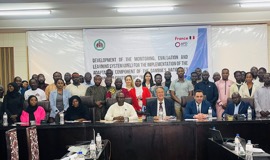
The event, held at Bakadaji Hotel on Tuesday, was organised to present and validate the baseline study on adaptation MEL, highlighting key findings across priority sectors including agriculture and food security, water resources, health, and coastal zone management. Participants also agreed on core elements and initial institutional arrangements for establishing a national adaptation MEL system aligned with the Paris Agreement’s Enhanced Transparency Framework (ETF) and the Global Goal on Adaptation (GGA).
Presiding over the opening, Deputy Permanent Secretary Bintou Gassama underscored the importance of the engagement, describing it as a vital step in strengthening national capacity to track progress, demonstrate results, and generate learning from adaptation actions. She noted that a robust MAL system is central to accountability under the Paris Agreement and to ensuring that climate interventions are effective, inclusive, and responsive to local realities.
With The Gambia on the verge of finalising NDC 3.0, she said the timing of the workshop could not have been more appropriate. Over the two days, discussions focused on aligning indicators, data systems, institutional roles, and learning mechanisms with national priorities, while addressing international requirements on adaptation transparency, baseline studies, and ongoing reporting processes.
Delivering the welcome remarks on behalf of the Climate Change Secretariat, Principal Climate Change Officer Modou Cham thanked stakeholders and development partners for their continued commitment. He stressed that monitoring, evaluation, learning, and reliable reporting are now indispensable for meeting national and international obligations. “Your presence today is a testimony to collective action,” he said, reaffirming government’s commitment to a multi‑sectoral approach to climate action.
His Excellency Stéphane Dovert, Chargé d’Affaires of France in The Gambia, described climate change as an existential threat. He warned that The Gambia remains one of the most climate‑vulnerable countries in West Africa due to its low elevation, dependence on the River Gambia, and reliance on climate‑sensitive sectors.
He outlined escalating risks including sea‑level rise, coastal erosion, salinisation of freshwater, flooding, rainfall variability, declining agricultural productivity, water stress, impacts on fisheries, rising temperatures, and increased health threats such as malaria and dengue fever. These pressures, he said, are already fuelling rural‑urban migration and socio‑economic strain.
H.E. Dovert reaffirmed France’s commitment through the AFD Adaptation Programme, noting that in 2024 alone, nearly €8 billion was committed to climate finance in developing countries, mainly in Africa. He explained that the MAL system under development would help The Gambia showcase its adaptation ambition and mobilise climate finance without increasing debt.
Nevertheless, he challenged both France and The Gambia to do more, describing the moment as a necessary wake‑up call for humanity. He also reflected on personal responsibility, urging individuals to rethink lifestyles that contribute to climate change.
Deputy Permanent Secretary at the Ministry of Finance, Ansumanna Sanneh, described adaptation as a macro‑fiscal priority. He said integrating adaptation metrics into economic and fiscal planning is essential to delivering the country’s NDC commitments as climate risks intensify.