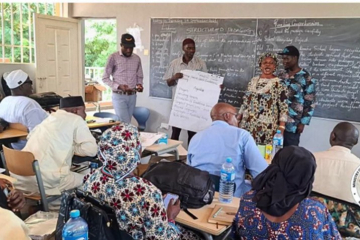
The programme, implemented by DCAF in partnership with the GID under the Swiss-funded project People-Centred Border Governance in The Gambia: GIS Reform Phase II, officially commenced on 15 June 2026 with Module One, a five-day Interpersonal and Professional Skills training workshop held at NaNA.
Speaking at the opening ceremony, DCAF National Project Officer Foday Fofana described the 20 officers as "not simply trainees, but pioneers," noting that the initiative is already emerging as a model of innovative and good practice in security sector reform.
Unlike conventional training programmes, the initiative is grounded in evidence. It was designed following a Gender Skills Audit conducted in April 2026, which surveyed 128 female officers across all ranks and regions of the GID. Led by National Gender Expert Isatou Ndow in partnership with DCAF, the audit identified both the strengths and development needs of female officers.
The findings revealed strong foundations in integrity, accountability, professionalism and gender-responsive practices. More than 90 per cent of respondents demonstrated high levels of ethical leadership and rights-based reasoning, while over 85 per cent were consistently accountable in their duties.
However, the audit also identified critical gaps in fraud detection, investigation, and intelligence processes; risk assessment and profiling; strategic leadership; digital literacy; and ICT systems. It further highlighted the need to strengthen communication, emotional intelligence, conflict resolution and stress management skills.
The initiative builds on the success of a similar EU-funded Gender Promotion Initiative implemented within the Gambia Police Force, in which 19 of 20 participating female officers were promoted to senior positions.
While acknowledging these achievements, Fofana emphasised that representation alone is insufficient. "Representation without capability is incomplete," he stated, stressing that the programme aims to ensure female officers are not only promoted, but also equipped, supported and empowered to lead with confidence, competence and credibility.
The programme consists of nine modules delivered over 41 training days and supported by mentoring, self-directed learning and on-the-job practice throughout the year. Training areas include interpersonal and professional skills, immigration enforcement and technical competencies, digital and ICT literacy, legal and policy frameworks, leadership and strategic management, gender-responsive operational practices, and personal development planning.
Assessment will take place throughout the 12 months, beginning with a baseline assessment and culminating in a final examination comprising written tests, practical simulations, portfolio reviews and oral interviews. Successful participants will receive a Certificate of Completion in Advanced Immigration Competencies for Female Officers, jointly awarded by DCAF and the GID/GIS, with certification recorded in their personnel files as evidence of competency for future promotion.
Addressing the participants, Fofana reminded them that their selection was intentional and reflected their leadership potential. He encouraged them to fully embrace the opportunity, describing the programme as both a privilege and a responsibility.
Ultimately, the initiative seeks to achieve a broader institutional goal: to embed gender equality within the structures, culture and leadership pathways of the future Gambia Immigration Service, ensuring that women's leadership becomes a permanent feature of institutional practice rather than a temporary project outcome.
Binta K.J. Barrow, GID Deputy Commissioner of Operations, noted this is one of the best training programs they are undertaking as it is tailored to their capacity gaps. “We are already learning a lot and are envisaging a changed us in terms of efficiency and professionalism”. She added that the GPI is set to produce more competent female GID officers.
As Fofana concluded, the true legacy of the programme will not simply be the certificates awarded after 12 months, but the leaders it produces and the generations of women they will inspire and mentor in the years ahead.
𝐃𝐂𝐀𝐅, 𝐆𝐈𝐃 l𝐚𝐮𝐧𝐜𝐡 𝐆𝐞𝐧𝐝𝐞𝐫 𝐏𝐫𝐨𝐦𝐨𝐭𝐢𝐨𝐧 𝐈𝐧𝐢𝐭𝐢𝐚𝐭𝐢𝐯𝐞 𝐭𝐨 s𝐭𝐫𝐞𝐧𝐠𝐭𝐡𝐞𝐧 f𝐞𝐦𝐚𝐥𝐞 l𝐞𝐚𝐝𝐞𝐫𝐬𝐡𝐢𝐩
Jun 19, 2026, 8:41 AM
4 min read
6a350109e0663
Press release
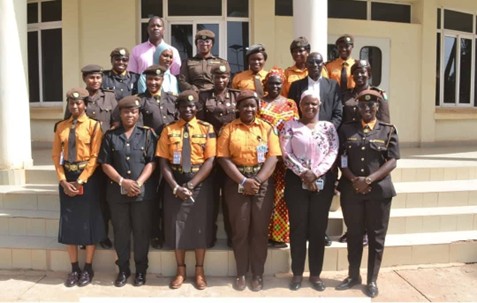
Twenty female officers of the Gambia Immigration Department (GID) have begun a 12-month Gender Promotion Initiative (GPI) aimed at preparing them for senior leadership, command and management positions within the institution as it transitions to the Gambia Immigration Service (GIS).
Read Other Articles
ITC, EU & gov’t launch workshop to shape creative industries policy
Sep 25, 2026
FLUG, GCCI sign landmark pact to strengthen labour-private sector relations
Oct 5, 2026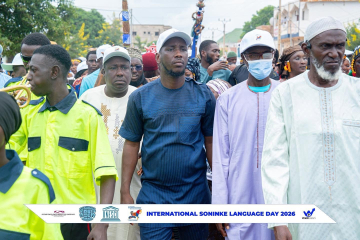
From oral tradition to global stage: Soninke Community marks 3rd Int’l Language Day
Oct 6, 2026
Basse Got Talent director completes China seminar on bamboo industry development
Sep 25, 2026
Walimang Foundation donates bags to schools in WCR
Sep 23, 2026