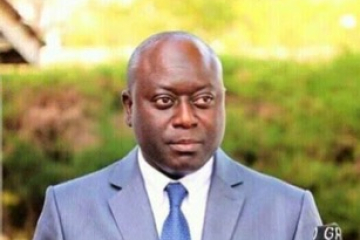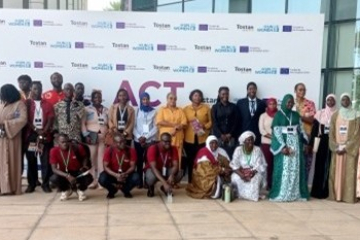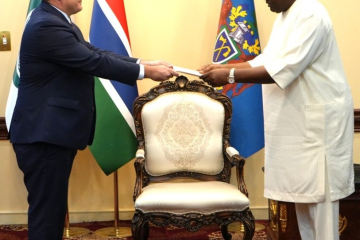
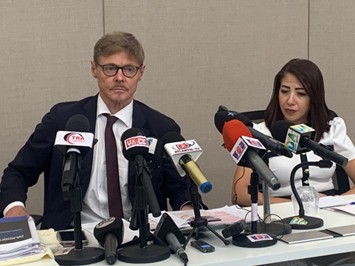
The Gambia has been hailed as a beacon of hope and a model of transitional justice by the United Nations Special Rapporteur on Extrajudicial, Summary or Arbitrary Executions, Dr. Morris Tidball-Binz. Speaking at the press conference of his two-week mission across the country, Tidball-Binz praised the resilience of Gambian journalists and the progress achieved since the end of authoritarian rule.
Highlighting the sacrifices of journalists such as Deyda Hydara, co‑founder of The Point, assassinated in 2004, and Ebrima Manneh, chief reporter arrested in 2006 and never seen alive again, Tidball-Binz said: “These are just two dramatic examples of the risks faced by Gambian journalists, who continued their vital work despite threats, arrests, and torture.”
The visit marked a clear departure from that of former Rapporteur Christoph Heyns in 2014, who was denied access to key sites including Mile Two Prison. This time, the delegation was granted full access to institutions, prisons, and remote regions, meeting with government officials, civil society, victims’ families, and international organizations.
Tidball-Binz praised the Truth, Reconciliation and Reparations Commission (TRRC) as a landmark achievement. “What the Gambian people have achieved in setting up the TRRC and implementing its recommendations stands as a model of best practice not only for West Africa but for the world,” he declared.
Acknowledging that justice remains a work in progress, the Rapporteur urged authorities to accelerate prosecutions and reforms. He noted ongoing cases, including the sentencing of officers responsible for custodial deaths, while calling for death sentences to be commuted to life imprisonment.
He also praised forensic doctors and investigators at Banjul’s main hospital, who are working with limited resources to support criminal investigations. Tidball-Binz appealed for international support in training fields such as forensic archaeology, anthropology, and genetics, envisioning The Gambia as a regional hub for forensic best practice.
Drawing parallels with Chile and Argentina, where truth‑telling and justice processes have spanned decades, Tidball-Binz emphasised that reforming security institutions and ensuring accountability takes time. “Old habits die hard,” he warned, citing documented cases of excessive police force since 2017, including the Faraba Banta shooting in 2018 and the death of Omar Badjie in September 2025.
Unlike the past, however, these cases were investigated, acknowledged by authorities, and led to suspensions of officers. “At least full impunity has not prevailed. This sends a strong message,” he said.
The Rapporteur concluded by praising Gambian journalists and civil society for their role in sustaining democracy and justice. “The dedication and commitment of the Gambian people have made these achievements possible. We all including the international community have a responsibility to ensure they remain, are sustainable, and are reinforced.”