The diagnostic focuses on five priority economic sectors identified for their relevance to job creation and inclusive growth: agribusiness, construction, information and creative technology (ICT), green and circular economy, and cultural and creative industries.
The study aims to contribute to national discourse on human capital development in The Gambia by assessing sector dynamics, employment potential, skills demand, constraints, and opportunities.
It also examined national, regional, and intercontinental access to market opportunities and key entry points for MSME growth.
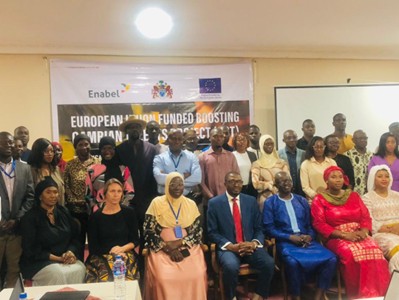
This initiative, implemented by Enabel (the Belgian Agency for International Cooperation) with funding from the European Union, is designed to strengthen the governance of mobility by linking it directly with entrepreneurship, innovation, and job creation.
Addressing the gathering, Ndey Haddy Jeng, Project Manager of Boosting Gambian Talent, said the validation was part of the EU-funded project’s efforts to understand the priority sectors deeply.
“We wanted to move beyond assumptions and take an evidence-based look at our priority economic sectors, focusing on Gambian human capital development,” she said.
The study, she added, was not about choosing the priority sectors for the project again, rather, it was about understanding them deeply, how they function and where the opportunities lie and most importantly, where the structural constraints to job creation and economic growth are.
‘‘What the report shows very clearly is that the Gambia does not lack economic activity across every business, construction, ICT, green and circular economy and the creative industries.”
The report, she added, shows that The Gambia has economic activity across the sectors, with growing participation, especially from young people and women.
However, transformation is not yet taking place, and economic growth is not translating into productive, stable, and formal jobs.
Key challenges highlighted include the dominance of informality, limiting income stability and growth, and limited access to finance, particularly for youth and women-led businesses.
Ousman Camara, representing SMD Policy Management Group, the consultancy firm that worked on the study, urged participants to scrutinise the report and provide input, especially on areas where gaps exist.
Lamin Camara, Permanent Secretary at the Ministry of Trade, Regional Integration and Employment, expressed appreciation to the EU for its support.
The report, he said, has come at a critical juncture for the national development agenda and confirms both progress and challenges in private sector development, human capital formation, and job creation.
This evidence-based report, PS Camara added, has come at a critical juncture for “our national development agenda”, citing that from the government perspective, the diagnostic confirmed both the progress achieved and the challenges that remained in private sector development, human capital formation and job creation.
While economic activity is expanding across key sectors and more young people and women are engaging in livelihoods and entrepreneurship, he added that the findings remind us that this has yet to translate into sufficient quality jobs, productivity gains and enterprise growth.
“It is a clear call to action. Our focus must shift from participation to transformation.”
PS Camara emphasised the need to shift focus from participation to transformation, invest in relevant skills development, strengthen the private sector, and ensure the quality of employment.
The findings align with the National Employment Policy and Action Plan 2022-2026 and the Labor Migration Strategy 2022-2026, targeting the creation of 150,000 decent jobs by 2026.