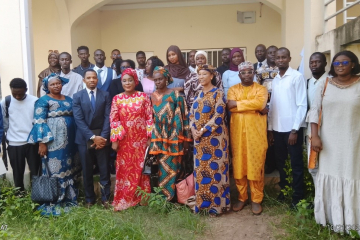
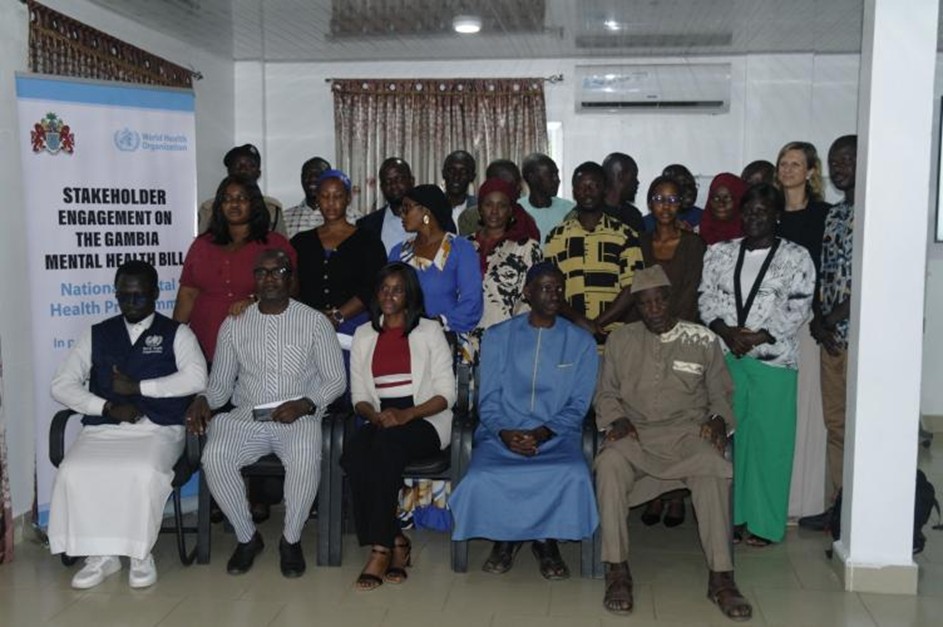
The forum attracted participants from government institutions, civil society organisations, professional organisations, academia, service user groups, and development partners to provide technical input into the draft legislation. When enacted, this new Bill will repeal the Lunatics Detention Act of 1917.
At the event, Mam Jarra Marega, Programme Manager for the National Mental Health Programme, who is also the National Technical Lead for the development of The Gambia Mental Health Bill, explained that the bill is the result of intense effort and a reflection of efforts that have spanned over a decade now.
“We started with the draft zero bill with support from WHO and we brought stakeholders together. This was the first time we tried to frame a progressive mental health legislation in the country and this is to have an impact on the mental health systems in general in the country.”
She observed that the recent one is comprehensive, rights-based and community focused, noting that it is scheduled for submission to the cabinet soon and later to the National Assembly for consideration into a Mental Health Bill.
NMHP Programme Director also talked about strides made in the past, the challenges and emergencies in the country.
“The draft Mental Health Bill 2025, represents the culmination of a legislative journey that began with a “draft zero” in 2014, evolved into a 2019 version, and has now matured into a comprehensive, rights‑based, and community‑focused framework.”
This Bill, she added, is scheduled to be submitted to Cabinet in the coming weeks and subsequently to the National Assembly for consideration, adding that the bill integrates mental health services into primary, secondary, and tertiary care, as well as schools, prisons, and community programmes, and ensures access to rehabilitation, psychosocial support, and community‑based services across the country.
Mrs Aisha Baldeh, an activist representing the Non-Governmental Organisations, on behalf of the CSO and the NGO communities, stated that the gathering was not just to discuss the document, but to shape the future of dignity, care and human rights for thousands of Gambians.
“CSOs being here symbolises our shared commitment to finding a common space, where every voice, especially most vulnerable, are heard,” she said. “We all work in communities where people are vulnerable, especially women and children.”
This bill, she added represents a turning point and that as CSOs, they see the daily realities on the ground.
Sally Jarju, president of the Association of Health Journalists -The Gambia, spoke of her association’s stance in promoting health issues in the country.
“As Health Journalists Association of The Gambia, we take issues of health very seriously, not just reporting on them, but also supporting the Ministry of Health in order for them to achieve their goal.”
The AOHJ prexy spoke at length on the role of the media in advocating for issues of mental health, but most especially the issue of the current bill being worked on.
Equally, she observed that mental health is not only a health issue, but a human right, a social and developmental issue.
Jarju noted that yet for far too long, mental health issue has remained under-reported and misunderstood by public largely due to stigma and stereotypes among a host of others.
Momodou Barrow, Emergency Preparedness and Response Officer at the World Health Organisation (WHO), on behalf of the country representative, acknowledged that the forum reflects their shared commitment to strengthening mental health-service provisions, while protecting rights and promoting best practices across the country.
Barrow revealed that WHO supports the Ministry to develop a new Mental Health Bill for The Gambia based on the urgent need to modernise existing legislations, which he said, no longer reflects current realities on the ground when it comes to service delivery, protection of rights and promotion of best practices in mental health care.
The bill, he added, will provide a clear legal framework to strengthen service provision, while safeguarding rights and dignity of individuals living with mental health conditions.
Declaring the forum open, Dr Momodou T. Nyassi, Director of Health Service at the Ministry, acknowledged that the forum marks another significant milestone in their collective journey to strengthen the country’s health systems.
For far too long, he said, mental health has been under‑resourced and under‑regulated, leaving vulnerable groups in dilemma.
“Today, as we consider this bill, we are charting out a new course that places dignity, rights, and access at the centre of care. The objective of this bill is clear and ambitious; first it provides a coherent and unified legislative framework for mental health, neurological and substance used services. Additionally, it protects the rights and freedom of persons living with mental and neurological substance-used condition ensuring that they are safeguarded from discrimination in all settings.”
Thus, he urged all stakeholders to contribute openly and constructively so that, together, they can deliver a Bill that is not only technically sound but also socially responsive and implementable.
Prof. Lamin Sidibeh, psychologist and a retired Mental Health veteran, also expressed similar sentiments, recalling some of their past advocacy efforts in creating awareness about this health condition in the country.