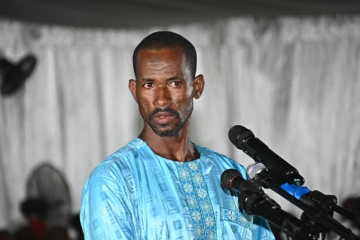
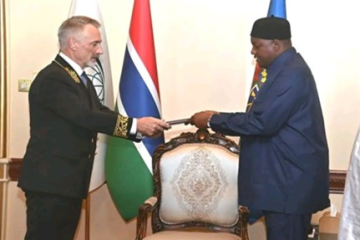
USET Vice Chancellor, Engineer Professor Nazmat Surajudeen-Bakinde, described the signing as more than a formal ceremony, but “a shared commitment to strengthen the connection between knowledge, innovation, intellectual property and national development”.
“Intellectual property is the oil of the 21st century. Hundreds of years ago they all made their money from extracting natural resources or moving them around. All today's richest men have their money out of intellectual property,” Prof. Bakinde said.
She said USET recognizes that research value does not end with publication, but must be translated into solutions, products, and enterprises. That requires a strong IP ecosystem “capable of identifying, protecting, managing and commercialising the innovations generated within our institutions”.
Prof. Bakinde cited cases where Gambians lost businesses for failing to patent ideas, including a case at USET during COVID-19.
“Choosing USET as the institute where to locate this institution is not a mistake,” she said. “I believe owning intellectual properties is like owning land. You need to keep investing in it again and again to get a payoff.”
She noted that USET’s mission is anchored on entrepreneurship, with its Institute of Innovation and Entrepreneurship (IIE) requiring students to acquire practical skills. She highlighted innovation week where students pitched projects are judged by industry, and winners are supported to register companies.
Recounting a story of a female USET graduate who planned to leave The Gambia but changed her mind after her team won $10,000 in a UNDP-UNIDO project, she said: “That is the kind of students and graduates we are raising in USET, and this GIPTI is going to even help us more.”
Prof. Bakinde thanked the World Intellectual Property Organization (WIPO), noting that more than 20 Gambians have been trained as resource persons, and reaffirmed USET’s commitment to making the collaboration “meaningful, sustainable and highly impactful”.
Registrar General at the Ministry of Justice, Abdoulie Colley, said the ceremony marks a significant milestone in strengthening The Gambia’s IP ecosystem and positioning IP as a strategic tool for innovation, creativity, entrepreneurship, and sustainable growth.
Mr Colley thanked WIPO Academy for its “unwavering support”, noting that WIPO has over 130 member states and has sponsored Gambians for Master’s degrees in IP.
“In today's rapidly evolving global economy, IP is no longer a peripheral legal concept. It has become a central driver of competitiveness, innovation, technology, advancement, investment, and wealth creation. Nations that effectively harness IP systems are better positioned to convert ideas into assets,” Colley said.
He further said the Institute will serve as a national centre of excellence for government officials, policymakers, judges, magistrates, lawyers, law enforcement, customs officials, researchers, students, innovators, entrepreneurs, artists, and business owners. He added that it would cover patents, trademarks, industrial designs, copyright, Geographical Indications, trade secrets, technology commercialisation, and enforcement.
“For our universities, including USET, IP training is essential to transform research outcomes into marketable products,” he said. “For businesses, it provides knowledge to protect brands. For creators, it gives tools to safeguard their creative works.”
Colley said the initiative is timely as the African Continental Free Trade Area (AfCFTA) requires Africans to trade among themselves, so entrepreneurs must be equipped to protect their rights across borders.
He also stressed sustainability, collaboration, and building local expertise. “The true success of this initiative will not be measured by the signing of this MoU alone, but the long-term impact and sustainability of the Institute,” he said, reaffirming the Ministry’s commitment.
USET Registrar, Alieu B. Saine, called the MoU “very symbolic” and aligned with USET’s mandate to train Gambians not only as engineers but as entrepreneurs and to safeguard formal and non-formal technicians.
Intellectual Property Officer and Project Coordinator at the Ministry of Justice, Bakary Colley, explained the evolution of GIPTI. He said the story started with a conversation at the WIPO Assemblies in 2025 between the Ministry of Justice and WIPO Academy on building IP capacity in The Gambia, which led to identifying USET as host.
“We began with an assessment questionnaire to understand the country's training needs. This was followed by stakeholder mapping and consultations,” he stated.
Awareness alone is insufficient, he said. “People need more than awareness. They need knowledge and practical skills. We want an entrepreneur to understand how to protect a brand. We want an innovator to know what to do before disclosing an invention. We want businesses to see intellectual property not simply as a legal concept, but as an asset.”
Colley said the IP Office is expanding outreach directly to young entrepreneurs in markets and workplaces, and that the MoU marks the transition to the second phase — translating plans into a functioning training programme.
All parties expressed confidence that the partnership will help build a culture where ideas are valued, innovations are protected, and IP becomes an instrument for economic and social development in The Gambia.