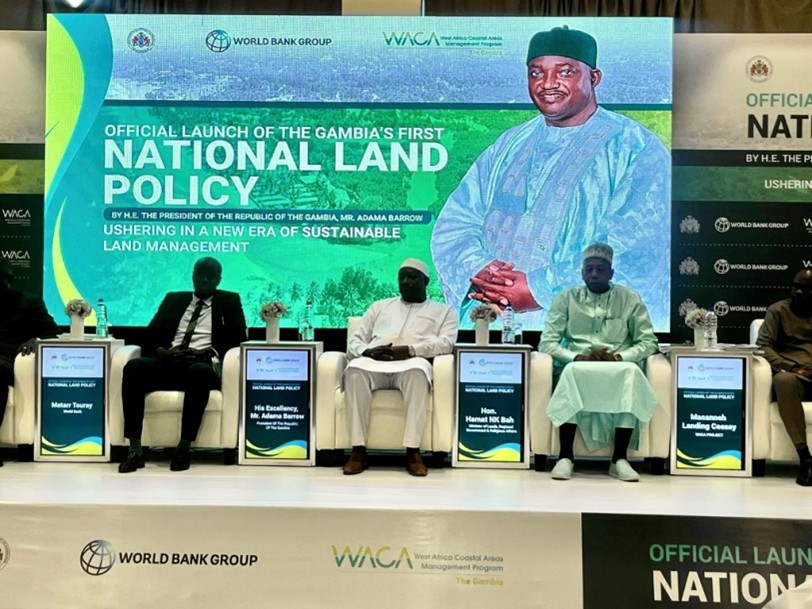
The national launch took place on 22nd December 2025 at the Sir Dawda Kairaba Jawara International Conference Centre, following a series of inclusive regional consultations and validations across the country. The formulation process was participatory and consultative, engaging stakeholders at national, regional, and community levels, including government institutions, traditional authorities, civil society, the private sector, women, youth, and vulnerable groups.
The primary objective of the National Land Policy is to address longstanding challenges in land administration, use, planning, and management. It aims to promote the effective and efficient use of land to support economic growth, job creation, poverty reduction, and environmental sustainability. The policy also seeks to reduce land-related conflicts, improve tenure security, and harmonise formal and customary land systems.
The Gambia covers a land area of about 11,300 square kilometres, with approximately 37.5 percent under forest cover. While arable land has expanded over the years, only about 57.3 percent is currently cultivated. At the same time, the country faces mounting pressure from rapid population growth, estimated at 3.1 percent per annum, and a high population density of 176 persons per square kilometre, making it the fourth most densely populated country in mainland Africa. More than half of the population lives in urban and peri-urban areas, intensifying challenges related to unplanned settlements, land degradation, and climate vulnerability.
Against this backdrop, the absence of a comprehensive national land policy has resulted in fragmented and often conflicting land governance approaches, unrecorded competing claims, overlapping institutional mandates, and weak land use planning. The new policy directly responds to these challenges by proposing a coherent legal, institutional, and technological framework for land tenure, administration, and use planning, while strengthening resilience to climate and coastal hazards.
The policy was developed with support from the World Bank through the West Africa Coastal Areas (WACA) Resilience Investment Project, in partnership with MoLRG&RA. The process followed a roadmap approved in February 2023 and updated in April 2024, ensuring alignment with national development priorities and international best practices, including the African Union Framework and Guidelines on Land Policy and the Voluntary Guidelines on Responsible Governance of Tenure.
Speaking at the launch, President Adama Barrow described the National Land Policy as a key achievement of his government’s reform agenda and a reflection of national development priorities outlined in the National Development Plan and the Recovery-Focused National Development Strategy. He noted that the policy aligns with international frameworks such as the Sustainable Development Goals and promotes equitable access, tenure security, and sustainable land management for all Gambians.
President Barrow said the National Land Policy 2026–2035 provides a forward-looking and unified framework to address longstanding and emerging land governance issues. He emphasised that the policy was developed through an inclusive and participatory process that recognises the country’s diverse land tenure systems and promotes transparency, climate resilience, gender responsiveness, and respect for human rights.
The policy is organised into seven interrelated chapters, covering the historical evolution of land governance, vision and goals, access to land and tenure security, land use planning and regulation, land administration, management of special land issues, and alignment with the Constitution. It also addresses informal settlements, environmental sustainability, protection of vulnerable groups, and the harmonisation of statutory and customary laws to reduce conflicts and strengthen accountability.
National consultant Abdou Touray highlighted that the journey to the policy’s adoption was made possible through strong leadership, coordination, and political commitment. He explained that the process involved a national steering committee, a technical committee, four thematic technical working groups, national and international consultants, and extensive consultations using research, focus group discussions, interviews, and technology-based engagement. Over 75 public, private, and civil society organisations contributed to the process.
Representing the WACA Project, Masanneh Landing Ceesay described the launch as a historic day for The Gambia, noting that the National Land Policy stands out as a unifying framework for fair, transparent and conflict-sensitive land management. He reaffirmed the project’s commitment to supporting land governance reforms, including improvements to land information systems, development control legislation, and institutional capacity.
He added that WACA’s support extends beyond policy formulation to building resilience through investments in infrastructure, livelihoods, and environmental protection, particularly along the vulnerable coastal zones. In The Gambia, the project is supporting restoration efforts in the Kotu Stream area and livelihood programmes for over 4,000 households, alongside a US$45 million grant aimed at reducing flood risks and strengthening institutions.
The launch of the National Land Policy marks a turning point in The Gambia’s land governance landscape, laying a strong foundation for sustainable development, social equity, and long-term resilience for present and future generations.