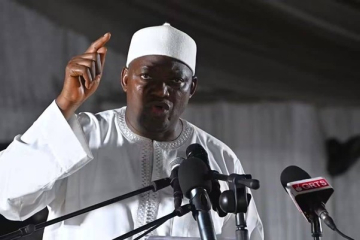
Speaking Monday at UN Headquarters, Jallow said the country is in a “decisive moment” nine years after Yahya Jammeh’s 22-year rule ended. “The Jammeh era is part of our history — but it will not define our future,” he said. “What we now ask is that the international community match our commitment with sustained, reliable support.”
Jallow highlighted major gains since 2017, including two cycles of peaceful elections and new laws across all areas of transitional justice. The TRRC held public hearings broadcast live for nearly three years. “By making truth-seeking a national conversation, this Commission dismantled denialism,” he said.
Government accepted 263 of 265 TRRC recommendations and launched a five-year Implementation Plan in January 2023, covering 304 activities and 59 institutions at an estimated cost of $150 million.
On reparations, the 2023 Victims Reparations Act set up a Reparations Commission and Fund. Government allocated D20 million to the Fund in both 2025 and 2026. President Adama Barrow calls it a “super priority,” Jallow said.
On accountability, Parliament passed four key laws since November 2023, including the Special Prosecutor’s Office Act. In December 2024, The Gambia and ECOWAS created a hybrid court, the Special Tribunal for The Gambia, to try Jammeh-era crimes.
But Jallow gave a frank update on delays. Citing the National Human Rights Commission, he said only 48 of 263 recommendations are fully implemented after three years. Another 133 are in progress, while 92 have not started. “Public confidence declines when implementation slows or is not clearly communicated,” he admitted.
Funding is the biggest obstacle. The hybrid Special Tribunal alone needs an estimated $60 million over five years, or $12 million annually. Domestic prosecutions require $2.5 million per year. The Reparations Fund needs sustained deposits beyond the D40 million allocated so far.
“The significant reduction of donor funded governance projects has created real pressure across all of these tracks,” Jallow said.
He said Government is finalizing a new National Strategy for Transitional Justice and Peacebuilding for 2026–2027. Priorities include operationalizing the Special Prosecutor’s Office and Special Tribunal, accelerating reparations, deepening community reconciliation, advancing security sector reform, and passing outstanding laws.
“The principal challenge today is not the definition of commitments, but their translation into outcomes that victims and communities can see and feel,” he said.
The Gambia asked the Commission for continued political support, funding for the Tribunal and reparations, and help sharing its experience with other countries.
“ECOWAS has provided its political and institutional endorsement for prosecutions. What is now required is funding,” Jallow said. “The architecture exists; what must follow are resources.”
He called the Peacebuilding Commission an “indispensable partner” since 2017. In 2025, The Gambia became the first country to undergo the UN’s Peacebuilding Impact Spotlight exercise.
“Since 2017, The Gambia has demonstrated that where there is political will, there is a way,” Jallow said. “Continue to stand with The Gambia.”