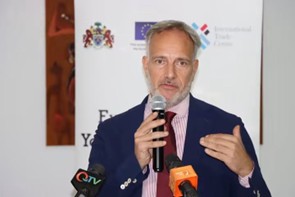
Brigandi commended the Gambian government, particularly the Ministry of Tourism, Arts and Culture and the Ministry of Trade, Industry, Regional Integration and Employment, for their leadership in advancing the national process. The European Union is supporting the initiative through its Youth Empowerment Project, implemented with ITC.
Highlighting the economic potential of cultural investment, Brigandi noted that “one dalasi or one euro invested in culture yields three in return’’. He explained that culture has a multiplier effect in tourism-driven economies, where visitors drawn by cultural offerings also spend on hotels, restaurants, transport, and services.
The country EU Deputy Head praised The Gambia’s rich cultural heritage and vibrant artistic community, pointing to opportunities in music, fashion, performing arts, digital content, film, crafts, and design. He stressed that these sectors could drive economic diversification, provided there is an enabling environment with sound policies, access to finance, relevant skills, and protection of creative assets.
The workshop, he said, is designed to answer a critical question: “What would it take for a young Gambian artist or creator to build a career and a business?” He encouraged participants to share experiences openly to ensure the policy is both ambitious and realistic.
Brigandi also welcomed the establishment of a technical committee to ensure inclusivity and consultation in shaping the policy. “A national policy will be stronger when it is shaped by those who will ultimately bring it to life,” he added.
Concluding his remarks, Brigandi reaffirmed the EU’s commitment: “The European Union remains a very committed partner of The Gambia and will continue working with the government, ITC, and all stakeholders to advance a dynamic, inclusive, and sustainable creative economy.”