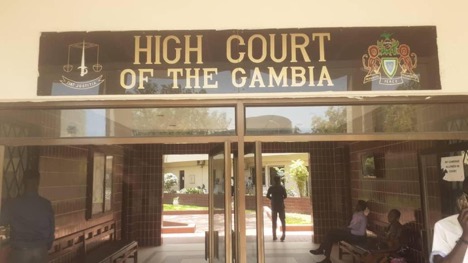
Sheriff Abba Sanyang and six others—Cherno Serending Sabally, Kalilu Sanyang, Bakary Gomez, Bakary Sanneh, Lamin Sabally, and Malang Jarju are facing a nine-count criminal indictment alleging land corruption, abuse of office, and criminal trespass.
The accused persons are alleged to have illegally sold portions of this state-forfeited land to private companies, fraudulently pocketing D13.1 million.
Hon. Justice Jaiteh’s warning came following the new prosecution lawyer Counsel Sunkary Camara, seeking an adjournment as she did not have proper instructions from her boss about the case.
That makes the third consecutive time the state has sought an adjournment as it is unable to proceed with the prosecution.
The lawyers representing the accused persons, Counsels Kebba Sanyang, and Lamin J. Darboe did not object to the prosecution’s application for an adjournment.
However, the two counsels raised concerns that if the prosecution is not forthcoming in the case, the court has the power to discharge the accused persons based on the law of the country.
“If the state has leveled charges against citizens, it is duty-bound on them to come to court and prosecute. But if they fail, the court can discharge the accused persons. The court has all powers to discharge the accused persons if the state is not forthcoming,” Counsel Sanyang told the court.
Counsel Darboe, aligned himself with the submission of Counsel Sanyang and stated that on the last adjourned date, he contended that the state can be granted an adjournment.
“But obviously, we are not going anywhere in this case. If the state is not forthcoming, the court can discharge the accused persons. The law is very clear as stated by my senior counsel Sanyang. If the state is not willing, then the court can exercise its power and discharge the accused persons,” Counsel Lamin J. Darboe submitted.
In delivering his ruling, Hon. Justice Jaiteh said the record of proceedings clearly demonstrates a pattern of repeated adjournments sought by the Prosecution, despite the matter having already commenced and the first prosecution witness being readily available to continue his testimony.
“The record shows that the first prosecution witness, Mr. Buba Sanyang, the Permanent Secretary at the Ministry of Fisheries, commenced his evidence-in-chief on the 20th day of April 2026 but did not conclude his testimony on that date. On the subsequent adjourned date, the 27th day of April 2026, Learned State Counsel Jobarteh informed this Court that the witness was present and ready to proceed,” Hon. Justice Jaiteh said.
However, Hon. Justice Jaiteh said an adjournment was sought on the ground that Counsel needed to obtain further instructions from his superior officers in relation to the matter. He said the Defence did not object to the application, and in the spirit of fairness and cooperation, the Court granted the adjournment as prayed.
Hon. Justice Jaiteh said the matter came up again on 12 May 2026. On that date, the Director of Public Prosecutions appeared for the State and sought another adjournment, stating that the case file was being reassigned to a different State Counsel.
Significantly, Justice Jaiteh noted that there was no mention of the need for further consultations or additional instructions—the grounds on which the Court had granted the earlier adjournment.
“This Court has considered the application for adjournment carefully in light of the constitutional imperative of a fair and expeditious trial,” Justice Jaiteh said. “While the Court appreciates that the State may, in appropriate circumstances, require adequate time to prepare its case, such latitude cannot be exercised indefinitely or in a manner that undermines the proper administration of justice.”
In unequivocal terms, he stated that the persistent changing of State Counsel, coupled with repeated claims of a lack of instructions or non-transfer of the case file, does not aid the expeditious disposal of the matter.
Justice Jaiteh stressed that such practices unnecessarily delay proceedings and inconvenience the Court, witnesses, defence counsel, and, most importantly, the accused persons who remain on trial.
He urged the prosecution to exercise greater diligence, coordination, and seriousness in handling the case, adding that criminal proceedings must not be conducted in a casual or disjointed manner.
“The Office of the Director of Public Prosecutions bears the solemn responsibility to ensure continuity of prosecution and proper preparation before appearing in court,” he said. “Repeated adjournments based on administrative or internal prosecutorial arrangements cannot become the norm.”
Justice Jaiteh also reminded the State that the accused are presumed innocent until proven guilty by credible and admissible evidence, in accordance with Section 24(3) of the 1997 Constitution of The Gambia.
He said this constitutional presumption remains firmly in their favour throughout the proceedings, and the Court has a corresponding duty to ensure they are not subjected to unnecessary delays or prolonged uncertainty caused by prosecutorial inefficiency.
“Notwithstanding the Court’s serious reservations about the conduct of the prosecution in this matter, and in the overriding interests of justice, the Court is minded to grant the State one final adjournment,” he said. “The prosecution will be accorded the benefit of the doubt, particularly given that the first prosecution witness is readily available to continue and conclude his testimony.”
Justice Jaiteh then “reluctantly” granted the State’s request for an adjournment describing it as a final indulgence.
Hon. Justice Jaiteh continued “The Prosecution is hereby put on firm notice that no further adjournment on similar grounds will be entertained by this Court. The State is expected to ensure that the assigned Counsel is fully instructed, properly prepared, and ready to proceed on the next adjourned date without fail. Failure to do so may compel this Court to take such steps as are necessary and permissible under the law to safeguard the integrity of the proceedings and the constitutional rights of the Accused persons.”
He then adjourned the case to the 23rd of June 2026.