The ruling came during the testimony of Seena Shams, the eighth prosecution witness (PW8), as the court continues to hear evidence in a matter involving alleged money laundering, dealing in prohibited drugs, possession of controlled substances and related offences.
Djabi is standing trial alongside two other accused persons.
The prosecution is led by State Counsel S.L. Jobarteh, while the defence team is headed by Counsel S.M. Tambadou.
PW8 told the court that he was a civil engineer and director of Construct Limited, a family-owned construction and real estate company based in Fajara. He explained that the company, owned by his parents, builds, sells and rents real estate and operates through several subsidiaries, including Fajara Waterfront Limited among others.
In his testimony, Shams said he recognised the first and second accused persons in court but did not know the third accused.
He recounted that in 2022 he was introduced to the first accused, Paulo Djabi, by Mariam Kaira, the owner of Linkage Africa, a company involved in real estate brokerage. According to him, Kaira introduced clients to his company and earned commissions on successful transactions.
Following the introduction, Shams said he communicated with Djabi via WhatsApp.
He told the court that a total of six properties were sold to Kaira, including plots identified as P7 at Fajara Waterfront, A3, G3, A6 and G6. He added that the transactions relating to A3 and G3 were not completed, prompting efforts to recover funds through WhatsApp communications.
The witness explained that although some of the properties were purchased in Mariam Kaira’s name, he understood that she was in a partnership with the first accused. He said Kaira informed him that Djabi had lent her money to acquire the properties because she could not afford them on her own.
According to PW8, payments for the properties were made through bank and wire transfers. He testified that the P7 property was valued at about US$450,000, while A3 was priced at US$300,000, with similar amounts for the other plots.
He stated that some of the transactions, or Payments were indirectly made by the first accused, whom he believed was financing the purchases by lending money to Kaira.
During the proceedings, the prosecution showed the witness several documents, including receipts, invoices, bank statements, payment plans and sale agreements, which he identified as documents generated in the ordinary course of business, however, he said the documents were not signed and the witness sought to verify from his office.
The prosecution subsequently applied to tender the documents into evidence.
The defence objected, specifically challenging the admissibility of the unsigned agreements of sale, arguing that there was no evidence showing they were executed as primary documents and that their unsigned nature affected their legal validity.
In response, the prosecution argued that the documents had been properly identified by the witness, were in standard form and were directly related to the transactions under scrutiny. State Counsel Jobarteh urged the court to dismiss the objection.
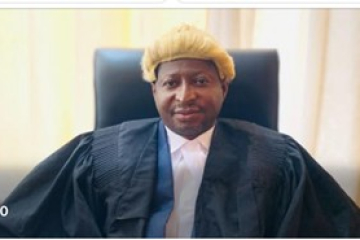
In his ruling, Justice Jaiteh held that the key issue at that stage of the proceedings was admissibility, not evidential weight. He explained that under Section 3 of the Evidence Act, evidence is admissible if it is relevant, and relevance is established if it tends to make a fact in issue more or less probable.
The judge noted that the charges before the court relate to property acquisition, financial transactions and construction-related dealings, and that the documents, taken collectively, were directly connected to those transactions.
He ruled that while the absence of signatures on some agreements may affect the weight to be attached to them, it does not bar their admission. Issues of authenticity and credibility, he added, can be fully tested during cross-examination and assessed at the conclusion of the trial.
Justice Jaiteh therefore overruled the defence objection and admitted the documents into evidence, marking them as Exhibits P-30, P-31 and P-32.
The case was adjourned until 19th January 2026.