The initiative, aimed at boosting agriculture and opening up access to farms and markets, underscores his pledge that no region will be left behind and no community disconnected. The North Bank Region alone will see new roads stretch across Lower Niumi, Jokadu and Badibou districts, signalling a major investment in rural infrastructure and balanced regional development.
The project, funded by the World Bank under a two-year programme, is part of Lot 2 of the wider GIRAV initiative. It is being carried out by Chino Gam, a Chinese construction company, with technical supervision from Pace and Ceetech Joint Venture (JV). The roads will be built using a Single Bituminous Surface Treatment (SBST), designed to ensure durability and smoother travel.
For farmers, traders and families across the North Bank Region, the project is expected to make the movement of people, goods and services easier, boosting local trade and improving livelihoods.
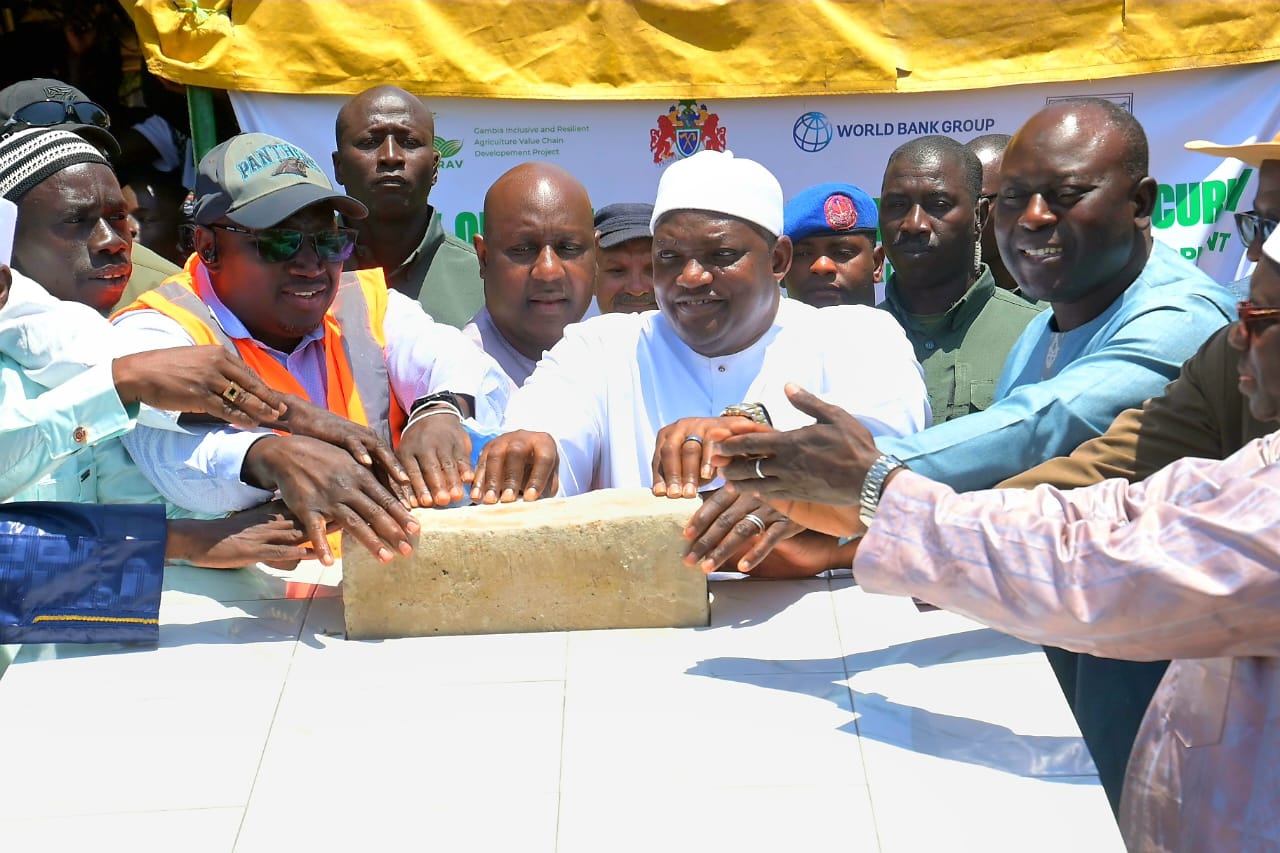
Speaking at a ceremony held at Njawara, President Barrow described the initiative as a decisive step in advancing his government’s strategic vision for national transformation. He said the project reflects an unwavering commitment to building a resilient, inclusive, and economically vibrant Gambia, as outlined in the National Development Plan and reinforced under the Green Recovery–Focused Development Agenda.
The feeder roads component, valued at US$25 million and fully financed by the World Bank, will link key agricultural production areas directly to major roads, markets, and essential social services. Barrow noted that poor road access has long constrained agricultural growth and rural development, leaving farmers struggling to transport produce efficiently and competitively.
“These roads are intended to change that reality,” he said. By facilitating the timely and cost‑effective movement of horticulture, rice, and cashew, the project aims to reduce post‑harvest losses, improve supply chain efficiency, and enhance market access. The President described the new feeder roads as “economic corridors that will connect production to prosperity.”
Beyond agriculture, Barrow highlighted the wider social impact of the investment. Improved rural roads, he said, will bring healthcare, education, and other essential services closer to communities, strengthening human capital development and advancing inclusive growth.
“This initiative is fully aligned with our broader infrastructure modernisation strategy, which prioritises integrated, climate‑resilient, and growth‑enabling investments,” Barrow explained. “We are not only expanding our primary and secondary road networks; we are ensuring that these networks reach the last mile, where the impact on livelihoods is most profound.”
The President expressed deep appreciation to the World Bank Group for its steadfast support, describing the partnership as a powerful example of how international cooperation can drive rural transformation.
Looking ahead, Barrow said the long‑term impact of the feeder roads will be transformative, stimulating rural enterprise, enhancing value addition, creating jobs, and improving incomes across agricultural communities. He added that the project would strengthen food security, reduce dependence on imports, and contribute to macroeconomic stability.
“Today, we are laying stones and laying the foundation for opportunity, dignity, and shared prosperity,” Barrow concluded. “We are building roads that will carry the hopes of our farmers, the ambitions of our youth, and the future of our nation. In short, we are building a Gambia that is connected economically, socially, and geographically.”
Speaking at the foundation stone‑laying ceremony for the feeder roads, Franklin Mutahakana, World Bank Country Director, recalled that the project was first approved in November 2021 with US$40 million, followed by an additional US$68 million in April 2024.
Mutahakana noted that agriculture employs about 70 percent of Gambians, but remains largely informal and underpaid, with declining productivity. He said the GIRAV project is designed to boost agricultural productivity, strengthen value chains, and help smallholder farmers and agribusinesses transition from subsistence to market‑oriented models.
He highlighted key achievements under the project, including support to over 53,000 farmers adopting climate‑smart technologies, improved food security for 426,000 people through the distribution of 1,000 tonnes of improved seed varieties and 15,000 tonnes of fertiliser, and US$11.1 billion invested in 400,000 agribusinesses. Beneficiaries contributed US$4.2 million in private capital mobilisation.