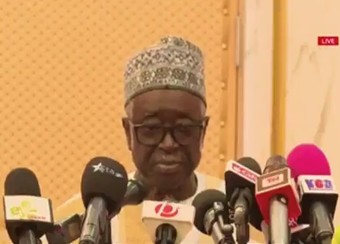
While acknowledging what he described as record-breaking progress in electrification, Senghore said water access remains an area that requires urgent attention.
“But when it comes to water, we have seen that development around that area is still lacking, especially in rural Gambia. We are calling on the president to work on that and give and provide water.”
He noted that the situation has led to a growing dependence on boreholes across many parts of the country, warning of its consequences.
“This is leading to every people digging boreholes in the country and most part of the country and we know this negative effect of boreholes in a nation,” he said, adding that the impact is well understood by experts.
“So we are calling on the president as the development he has done when it comes to electricity, we want him to do the same when it comes to water access, especially in the rural Gambia and some part of the urban,” he added.
Despite the concerns raised, the Banjul Muslim Elders used the occasion to express appreciation for what they described as significant development under the current administration.
“We need to thank the president for the development he has done in the country, especially Banjul, it is an obligation for someone to give gratitude to someone who has done good for you and that is what the Banjul Muslim Elders are doing.”
He said the elders sincerely appreciate the work done not only in Banjul but across the country, particularly in infrastructure.
“We have seen most part of the country having good roads, electricity among others. This needs applause from the citizens of the country,” he said.
Highlighting electricity as a major success, Senghore pointed out that The Gambia now boasts over 90 percent coverage, a figure he described as unmatched in many parts of Africa.
“We have not seen, most African countries have even 60 or 50 percent electricity project but The Gambia has over 90 percent electricity,” he said, adding that there is a promise to extend electricity to the remaining areas before the end of the year.
“This is record-breaking, I’ve been to so many African countries even 60 percent of electricity, they don’t have it but we have more than that.”
Beyond water, Senghore also raised concerns about other issues affecting citizens, including cement shortages and infrastructure challenges in Banjul.
He called on the Ministry of Trade to address the recurring cement shortages, noting that although the situation has improved in recent months, it had previously caused frustration.
“We want you to ensure that the shortages every now and then end because it affects the economy and that brings frustration to citizens,” he said.
He further highlighted drainage problems affecting the main mosque in Banjul, especially during the rainy season, and appealed for government support.
“We are doing our part by painting, changing carpets but this is beyond our capacity,” he said, stressing the importance of the mosque as a central place of worship and a venue for receiving important guests.
He concluded with a renewed call for government intervention, particularly in addressing drainage challenges at the mosque.