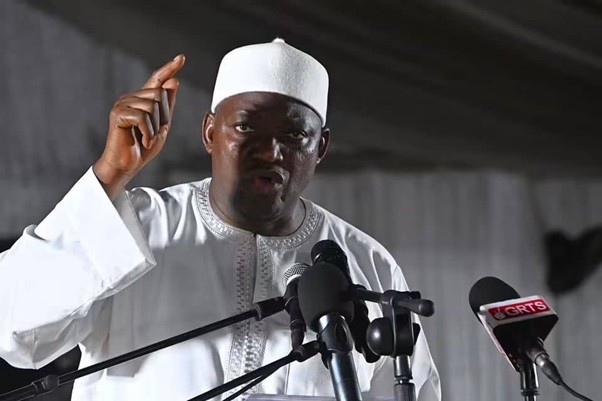
President Adama Barrow said his government has added over 11,000 qualified teachers and created more than 23,000 government jobs in the last 10 years, reducing unemployment from 9.4 per cent to 6.2 per cent.
Speaking at Manduar in Brikama South during his Meet the People Tour on October 14, 2026, President Barrow said the number of government employees rose from 54,044 in 2016 to 77,033 in 2026, while qualified teachers at lower basic, upper basic, basic cycle and senior secondary levels increased by 59 per cent overall, from 5,290 to 7,737 at lower basic alone.
"When I came to power, the number of people working under the government was 54,044. Today, the number stands at 77,033. At the lower basic level alone, we had 5,290 qualified teachers; today we have 7,737. When all these figures are calculated, the number of qualified teachers has increased by 59 per cent during my 10 years in office," President Barrow said.
The Gambian leader has outlined what he described as significant development gains under his administration over the past 10 years, comparing figures for electricity, roads, education and health with those from the previous 50 years.
On electricity, the President said that between 1956 and 2016, only 195,244 people had electricity meters installed in their homes. In his 10 years in office, he said 287,130 people have had meters installed.
Barrow gave a regional breakdown, stating that in the North Bank Region, only 40 villages had electricity in 50 years, while 204 villages have been connected under his government. In the Central River Region, 23 villages had electricity in 50 years compared to 355 villages in 10 years. In the Upper River Region, 32 villages had electricity in 50 years compared to 220 villages now. In the Lower River Region, 14 villages in 50 years compared to 82 villages, and in the West Coast Region, 101 villages in the previous 50 years.
"In total, the two previous presidents oversaw electricity for 109 villages across The Gambia over 50 years. Under my government, 962 villages have been provided with electricity in 10 years," he said.
On road construction, President Barrow said 855 kilometres were built before 2016, while 1,502 kilometres have been constructed in his 10 years.
In education, he said 10,001 classrooms were built in the previous 50 years, while 77,155 classrooms have been built over the last 10 years, averaging 800 per year compared to 210 previously. He said 241 classrooms were built in public schools alone. On ICT and science infrastructure, 235 schools had computer laboratories in 50 years compared to 258 under his government, 158 schools had science labs compared to 156 added in 10 years, and 634 schools had separate toilet facilities compared to 596 provided in the last decade.
On qualified teachers, he said lower basic increased from 5,290 to 7,737, an increase of 48 per cent; upper basic from 2,877 to 3,988; basic cycle from 1,450 to 1,877; and senior secondary from 1,560, representing an 83 per cent increase, bringing the overall increase to 59 per cent.
Barrow also cited university expansion, saying The Gambia had one university after 50 years and his government added three more, the University of Education, University of Science and Technology and University of Civil Service plus a university in Faraba built at a cost of almost D150 million.
On employment, Barrow said government workers increased from 54,044 to 77,033, while unemployment dropped from 9.4 per cent to 6.2 per cent.
On agriculture, he said fertiliser price was reduced from D1,250 to D1,100 per bag with a D1,850 subsidy, while groundnut price increased from D15,000 per tonne to D38,000.
Barrow listed youth training programmes including 925 under Navy Enterprise Training, 200 under NYSS, 151 apprentices and 100 graduate interns, plus farming and beekeeping initiatives.
President Barrow said the government spent D190 million on Brikama Ba Major Health Centre and over D290 million on Bwiam General Hospital, built 11 health posts, five health centres, renovated three, and purchased 129 ambulances to add to 60 inherited.
The Gambian leader said the figures were presented for clarity after listening to previous speakers, noting that if such work had been done earlier, The Gambia would be further ahead in development.