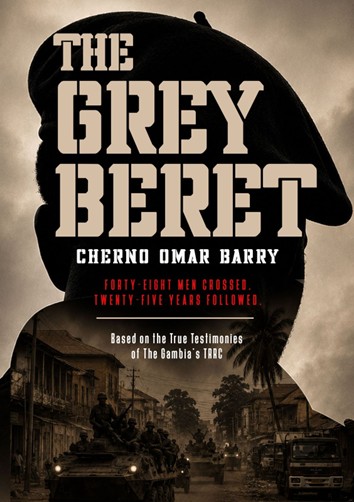
A novel by Cherno Omar Barry • 2026
In the early hours of 22 July 1994, an army column commanded by a 29-year-old lieutenant crossed Denton Bridge into Banjul, the capital of The Gambia, and brought down the government of Dawda Kairaba Jawara, who had led the country for 29 years. The president, evacuated to an American naval ship that happened to be in port for a courtesy call, sailed for Senegal that evening. The lieutenant, Yahya Jammeh, would remain in State House for the next 22 years.
The Grey Beret, the debut historical novel by Gambian author and publisher Cherno Omar Barry, is the story of those years and of the work that has begun, since Jammeh's departure in January 2017, of placing them in the record.
Built from the testimony given before the Truth, Reconciliation and Reparations Commission (TRRC), which sat for nearly three years and produced more than 17,000 pages of public record; from the TRRC's Criminal Liability Findings, released on 24 December 2021; from the proceedings of the High Court of Banjul (which convicted Yankuba Touray of the murder of Finance Minister Ousman Koro Ceesay in July 2021); from the Bellinzona conviction of former Interior Minister Ousman Sonko in May 2024; from the extradition of Jungler Sanna Manjang from Senegal in late 2025; and from the published memoirs and contemporary journalism of the period — the novel narrates the regime's atrocities with the documentary fidelity that the historical material demands.
Its central figure, Lieutenant Amadou Sow, is a fictional composite drawn from the documented TRRC testimony of Lieutenant Amadou Suwareh. Other composites include the officer's wife Fanta, the Finance Minister's secretary Fatou Camara, and Sergeant Major Ebrahim Chong (drawn from AIG Ebrima Chongan's memoir The Price of Duty). The named victims — Ousman Koro Ceesay, Deyda Hydara, Lieutenant Gibril Saye, the eleven dead of November 1994, the nine death-row inmates executed in August 2012, the 56 West African migrants killed in July 2005, and others — appear because they are in the public record.
Written in an omniscient third-person narrative voice that moves across institutions and decades, The Grey Beret takes its place alongside the major literary works of the African political novel: Chimamanda Ngozi Adichie's Half of a Yellow Sun, Aminatta Forna's The Memory of Love, Petina Gappah's Out of Darkness, Shining Light, and the early novels of Tsitsi Dangarembga. It is the first novel of literary ambition to take the architecture of a Truth Commission as its closing movement, and the first novel to attempt the full literary record of The Gambia under military rule.
The Gambia is small. The book is not. The novel runs to approximately 280 pages, 30 chapters, and 5 parts, from the airport humiliation of 21 July 1994 to the long present-day current of the Gambia River. It is published in 2026, in a moment when the prosecutions begun by the TRRC are still proceeding — and when the question of what a country owes its dead has not yet been settled.
★ ★ ★
Pull quotes from the novel
“I may have just handed a country to men who will burn it.”
— Lieutenant Amadou Sow, after Denton Bridge, 22 July 1994
“When the disgruntled officers arrived, I think much to their surprise, it was theirs.”
— Andrew Winter, US Ambassador to The Gambia, on the morning of the coup
“The cheering was real. It would not survive the year.”
— from Chapter 3, The Empty House
“The Armed Forces Provisional Ruling Council wishes to assure all citizens and residents of The Gambia that their lives and property are safe. They said it twice. Nobody had asked.”
— from the first AFPRC broadcast, evening of 22 July 1994
“The grief was private. The newspaper was public. I learned to keep them separate. I am still learning.”
— daughter of Deyda Hydara, TRRC testimony
“This is what the Commission could do. It is not enough. It is not nothing.”
— from Chapter 26, The Families Testify
“The law is careful. The law has its own pace. The families wait.”
— from Chapter 27, The Litany
“I would have tried to save my men.”
— Sow at the Commission, 25 years on
“The river was here before the country. It will be here after.”
— from Chapter 30, The River
“The record is complete. The reckoning is not.”
— the novel's closing line
★ ★ ★
Author biography
Cherno Omar Barry is a Gambian author, scholar, and publisher based in Brusubi. He is the author of works of literary criticism, cultural history, and historical fiction. The Grey Beret is his debut novel. A companion non-fiction volume, Behind Bars, will be published in 2026.
10. Themes, keywords, and BISAC categories
For library cataloguing, SEO on the publisher's site, retailer category placement, and festival programming. The themes also serve as quick reference for journalists looking for the angles a feature could take.
Principal themes
- Military rule, dictatorship, and the slow architecture of state violence.
- Truth commissions and transitional justice in post-conflict societies.
- The moral burden of complicity — the soldier who facilitates rather than fires, and what he carries.
- Memory, testimony, and the work of placing names in the public record.
- The family as the keeper of national silence: wives, mothers, daughters, and the cost of carrying what cannot be spoken in public.
- The journalist, the imam, the minister, and the prisoner as the moral stations through which a regime's pressure is read.
- West African political history of the late twentieth and early twenty-first centuries.
- The country as the protagonist — a national novel in the tradition of Adichie, Ngugi, and Mengiste.
Keywords
The Gambia. Yahya Jammeh. Truth and Reconciliation Commission. TRRC. military coup. dictatorship. West Africa. transitional justice. historical fiction. African literature. political novel. Banjul. Denton Bridge. Junglers. Mile 2 Prison. Ousman Koro Ceesay. Deyda Hydara. AFPRC. 1994 coup. universal jurisdiction. Bellinzona. Sonko trial. crimes against humanity. memory. testimony. literary fiction. omniscient narrator. national reckoning.
BISAC categories
- FIC014000 FICTION / Historical / General
- FIC051000 FICTION / Cultural Heritage
- FIC081000 FICTION / Political
- FIC096000 FICTION / African
- FIC019000 FICTION / Literary
★ ★ ★
11. Reading-group discussion guide
For book clubs, university courses (African literature, postcolonial studies, transitional justice, comparative politics), and reading-group publicity material. Eight questions, sequenced to lead a discussion from the personal toward the political and back.
Eight questions for discussion
- The novel opens with Lieutenant Amadou Sow's decision at Denton Bridge on the morning of 22 July 1994 — to negotiate rather than fire, to let the coup column cross. Was it the right decision? At the Truth Commission twenty-five years later, Sow tells the commissioners: I would have tried to save my men. Is that a sufficient answer? Is it the only honest answer?
- The narrator says of the morning that the country had been handed to the men with rifles by the man they had been overthrowing — that Jawara, by ordering no resistance, had effectively delivered the State House to the soldiers. How does this change the reader's understanding of what is usually called the bloodlessness of the 1994 coup? What does the country lose by having remembered the day differently for twenty-two years?
- The wife Fanta is described as carrying the domestic record of the regime — the silences, the sleeplessness, the cost of being married to a man who once stood at the front of a column. How does the novel treat the women who held households together through the Jammeh years? What weight do their interior chapters bear in the architecture of the book?
- Chapter 27, The Litany, presents the TRRC's criminal liability findings as a religious-grade act of naming — the dead first, the perpetrators second. Why has the author chosen this order? What is the relationship between the work of a Truth Commission and the work of religious mourning? Does the chapter succeed in being a literary text rather than a list?
- The novel includes named real victims (Ousman Koro Ceesay, Deyda Hydara, Lieutenant Gibril Saye, the eleven dead of November 1994, the nine executed in August 2012, the 56 migrants of July 2005, the named victims of the Junglers) and composite figures (Sow, Fanta, the secretary Fatou Camara). What are the ethical responsibilities of a novelist who places real victims alongside invented characters? Where does the novel succeed in honouring this responsibility, and are there moments where you felt it was tested?
- The grey beret is the novel's central symbol — the colour of the Gambia Police Tactical Support Group, the colour Sow refused to turn black on the morning of the coup, and the colour he was still, in a sense, wearing twenty-five years later when he testified. What does the beret stand for in the novel's moral economy? Is keeping it grey an act of integrity or an act of self-deception?
- The novel's closing line is: The record is complete. The reckoning is not. What is the difference, in the world the novel has built, between a record and a reckoning? In a country where the criminal liability findings have been published but the trials are still proceeding — and where the principal accused remains in exile — what does it mean to call the reckoning incomplete?
- The Grey Beret is set in The Gambia, but its concerns — military rule, the disappearance of citizens, the slow work of truth commissions, the cost of complicity, the question of what a small country owes its dead — are not unique to one place. What other national reckonings does this novel illuminate? Where else in the world is the work the novel describes still being done?
★ ★ ★
Usage notes
Channel-by-channel recommended deployment
- Print jacket back cover → item 2 (back-cover blurb, ~150 words).
- Print jacket inside flap → item 5 (pitch paragraph) plus item 9 short bio.
- Publisher's website book page → item 3 (publisher's description, ~250 words) plus item 9 long bio plus a selection of 3–4 pull quotes from item 7.
- Sales catalogue / rep sheet → item 1 principal tagline plus item 5 pitch paragraph plus item 6 comp titles plus item 9 short bio.
- Press release → item 4 (~500 words) plus item 8 (why now) plus item 9 long bio.
- Trade announcement (Bookseller, Publishers Weekly etc.) → item 1 principal tagline plus item 5 pitch paragraph plus item 6 first paragraph (the African literary novel comparators).
- Social media at launch (Instagram, X, LinkedIn) → rotate the pull quotes from item 7, paired with the cover image; use item 1 alternate taglines for ad copy.
- Festival and event programming → item 5 pitch paragraph plus a 2–3 question version of item 11 reading-group guide.
- Book club marketing inserts → item 11 (the full eight-question discussion guide) plus a short version of item 9 (long bio).
- University course adoption → item 4 (press release synopsis) plus item 10 themes/keywords plus item 11 (discussion guide) plus item 6 third paragraph (post-conflict/transitional justice positioning).
- Library and retailer SEO / cataloguing → item 10 (keywords and BISAC categories).
Editorial flexibility
These materials are tuned to the same register as the novel — restrained, historically literate, morally serious. They can be made warmer (for the publisher's social channels), more academic (for university adoption), or more headline-driven (for trade media) by light editorial adjustment without losing the central frame. The voice across all eleven items is consistent on purpose: a publishing campaign that reads as written by one hand carries a different authority than one assembled from competing copy.
On the comp titles
The comparators in item 6 are calibrated for the international literary market. For a Gambian and West African market, the comparators can be different — the early novels of Tijan M. Sallah, the work of Lenrie Peters, the more recent fiction of Ndaba Sibanda and Sulayman S. Nyang, the editorial nonfiction of Ebrima Chongan (The Price of Duty) and the journalism of Demba Ali Jawo. A Gambian market sales sheet can substitute these in for the international comparators.
On the trigger warning question
The novel contains documented references to murder, torture, sexual violence, the killing of journalists, the killing of West African migrants, the killing of elderly women in the 2009 witch hunts, and the execution of death-row inmates in 2012. The references are handled with the restraint the novel requires — no spectacle, no invented atrocity, no entry into victims' final thoughts — but the material is grave. For book club marketing and university adoption, a brief content note may be appropriate. Suggested phrasing: This novel contains references to documented historical violence, including political murder, sexual violence, and the killing of journalists and migrants. The references are restrained and grounded in the public record. Readers approaching the book in survivor-support contexts may wish to know this in advance.
On future updates
The Why now paragraph (item 8) is calibrated to the news cycle of mid-2026. It should be reviewed and lightly updated whenever the prosecution news changes — new arrests, new convictions, new extraditions, the indictment of Jammeh in any new jurisdiction. The TRRC website (trrc.gm) and the news desks of The Standard, The Point, and Foroyaa are the principal sources. A six-monthly review is recommended through the active prosecution period.