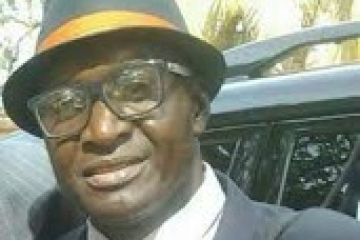
Three Years On, the Roman Jurist of The Gambia, the Shakespearean voice of law, the Oxford jurist who spoke Latin, the rhetorician who walked in eloquence and wrote with thunder\
Fatoumatta: Dr. Henry Carroll, remembered for his bombastic eloquence, his devotion to titles, and his mastery of Latin, stood among The Gambia's most prolific legal commentators, a scholar whose essays, rebuttals, and public interventions shaped national discourse alongside fellow legal minds like Dr. Lamin J. Darbo and legal Scholar and international lawyer Omar Mbai. Three years after his passing, and four days after the loss of his elder brother, Lawyer Wilfred Bola Carroll, the nation still feels the silence left by a man who spoke like Cicero, argued like a Roman jurist, and carried himself with the theatrical dignity of a Shakespearean advocate.
Three years have passed since Dr. Henry Darlington Richmond Carroll's departure, and yet his voice still reverberates through the corridors of Gambian jurisprudence. His passing did not silence him; it amplified him. His absence did not diminish him; it clarified him. As we remember him today, we do not merely honor a lawyer; we honor a phenomenon, a scholar whose intellectual voltage lit up every room he entered.
Henry Carroll was not simply a legal practitioner. He was a spectacle of intellect, a rhetorical force, a scholar whose command of language made every lecture, argument, and article an event. He spoke English with a grammarian's precision and Latin with a Roman jurist's confidence. His courtroom interventions were operatic; his public lectures, symphonies of jurisprudence; his newspaper essays, intellectual thunderstorms. He was extroverted, bombastic, flamboyant in diction, and unapologetically in love with the majesty of words. He carried himself with the theatrical gravitas of a Shakespearean actor delivering a soliloquy on justice.
He was, in every sense, the quintessential British‑trained Gambian lawyer, tailored suits, polished shoes, crisp shirts, and the unmistakable bearing of a man who had walked the halls of Oxford. His degrees — LLB (Hons), BL (Hons), LLM, PhD — were not decorations; they were instruments. He wielded them with the seriousness of a man who believed that scholarship was a civic duty. As Registrar of Companies at the Attorney General's Chambers, he brought rigor to corporate governance. As Senior Law Lecturer at The Gambia Technical Training Institute from 1994 to 2023, he shaped the intellectual architecture of Gambian legal education.
He was my senior at Saint Augustine's High School, a young man already brimming with lexical exuberance, theoretical showmanship, and a mastery of Marxian polemics that made him unforgettable. Later, as we both entered public discourse, we often and vigorously disagreed on public policy and governance. We exchanged rebuttals and rejoinders, each sharpening the other. Our disagreements were never hostile; they were intellectual duels, fought with respect, wit, and the shared belief that ideas must be tested in the fire of argument.
One of our most memorable public confrontations came in 2019, during the constitutional crisis surrounding the removal of nominated National Assembly member Ya‑Kumba Jaiteh. Henry, with his characteristic thunder, defended President Adama Barrow's decision with Latin maxims and British‑style legal flourish, insisting that only lawyers were qualified to contest points of law. He demanded apologies for the President. He wrote with the bombast of a scholar who believed deeply in his interpretation. And I responded with equal force, armed with constitutional reasoning and the barrel of ink that has always been my refuge. It was a duel of scholarship, a clash of constitutional visions, a moment when two minds who loved the law confronted each other in the public square.
Fatoumatta: Henry's rhetorical voltage was unmatched. He spoke with Cicero's confidence and the theatricality of a Shakespearean actor. His speeches were embroidered with Latin maxims: Fiat justitia, ruat caelum; Audi alteram partem; Nemo judex in causa sua — not as ornaments, but as intellectual anchors. He believed that language was not merely a tool of law, but the very architecture of justice. His mastery of Latin was not performative; it was foundational. He read and wrote academic and literary works in both English and Latin, participating in a world of intellectual life that many Gambians could only glimpse from afar. He was humorous, quick‑witted, satirical, and endlessly generous. No conversation with him was ever dull. He was a factory of ideas, a rare, productive thinker, and a public intellectual who believed scholarship must serve society.
He also regularly contributed legal commentary to Gambian newspapers, a familiar name in the national press, writing alongside fellow legal minds like Dr. Lamin J. Darbo and now international lawyer Omar Mbai. Henry believed that the law must live in public discourse, not only in courtrooms. He wrote with thunder, with flourish, with titles fully displayed, insisting that every earned honor be spoken, respected, and acknowledged. He believed scholarship must be visible, intellect public, and the law loud enough for citizens to hear.
His passion was education, not as a profession, but as a salvation. He believed Africa's future depended on elevating the mind. He mentored young scholars in The Gambia and across the diaspora. He gave himself to the nation even when the nation repaid him with indifference. He fought the good fight, finished the race, and kept the faith.
His death was not merely a personal loss; it was a national wound. It silenced a voice that had become part of the country's intellectual conscience. It dimmed a light that had illuminated the path of legal reasoning for decades. It left a void that cannot be filled, only honored.
And yet, even in death, Henry Carroll continues to teach. His writings remain alive. His speeches remain quoted. His Latin maxims remain recited. His intellectual fingerprints remain on the minds of lawyers, judges, scholars, and students who carry his legacy forward.
He was a master potter of minds. He molded giants. He produced thinkers. He forged advocates. He sharpened public intellectuals. He shaped the legal minds who would serve the First, Second, and Third Presidents of the Republic. He mentored lawyers who now carry his intellectual DNA into courtrooms and classrooms across the nation. His legacy is not merely remembered; it is lived.
On this solemn anniversary, we remember something deeper, something almost mythic. Four days after Henry's passing, his elder brother, Lawyer Bola Carroll, followed him into eternity. Two brothers. Two jurists. Two gentlemen of the law. Two pillars of Gambian jurisprudence. Their deaths, separated by only three days, remain one of the most heartbreaking chapters in our national memory. It was as though the heavens, in their inscrutable wisdom, decided to extinguish these two torches together.
Fatoumatta: But their legacies endure, not as fading embers, but as enduring flames. Rest in peace, Dr. Henry Darlington Richmond Carroll. Your eloquence still echoes. Your scholarship still instructs. Your Latin still resonates. Your legacy still guides. And may you rest beside your brother, Lawyer Bola Carroll, two giants whose names will never die.