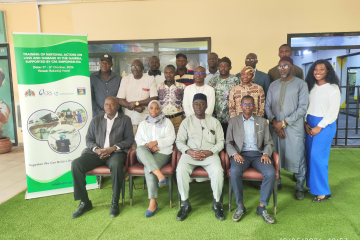
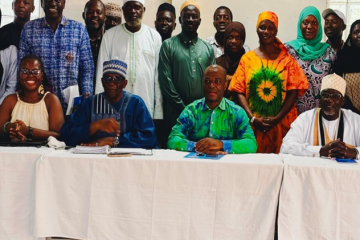
By aligning a TVET institution with the Maritime Administration, the collaboration seeks to transforms the labour force from being merely "educated" to being "industry-ready".
“As the Maritime Administration, our oversight is to ensure safety, security and safety of navigation in our territorial waters, as well as enhancing the maritime industry. Key among those enhancements is to ensure that you have trained and available seafaring communities to be able to participate fully in the blue economy,” Mr. Ousman Touray, Deputy Director General of GMA said at the signing ceremony.
Mr. Touray said the MOU is a gateway for reducing unemployment in the country. He said the blue sector is a sector that is yet to be tapped.
Touray believes that with Gambia as a youthful nation, GMA has to take the bull by the horns and venture into the blue sector. He said this can only happen effectively when there is a trained seafaring community. He added that Crab Island TVET Foundation is a stepping stone in supplying these skilled seafarers to ship owners there.
Mr. Touray further recommend to Crab Island TVET Foundation to embark on a very good outreach to popularise the program.
“Because the knowledge and the opportunities that this blue sector is offering are not known to many Gambians. You can do outreach to these schools, senior secondary schools, junior secondary schools, to parents,” he said.
Hon. Ousman Sillah, chairperson and founder of Crab Island TVET centre, said the signing of the MOU with GMA marks the beginning of a strategic partnership grounded in a shared vision: a vision to strengthen technical and vocational education and training, to build relevant skills, and to prepare our people for meaningful participation in the maritime and blue economy sectors.
Hon. Sillah said it brings together two institutions with complementary mandates: one focused on delivering demand-driven technical education, and the other entrusted by law to regulate, monitor, and promote maritime activities in The Gambia in line with international standards.
“Crab Island TVET Foundation was established with a clear mandate—to expand access to quality, industry-relevant technical education and to ensure that training is not only theoretical, but practical, need-driven, and responsive to national development priorities. Through our TVET Centre, we aim to equip young people and professionals with practical, employable skills that respond directly to labour-market needs,” he said.
Hon. Sillah said that skills training must be aligned not only with industry expectations, but also with national regulatory frameworks.
The maritime sector, he added, presents enormous opportunities from port operations and marine mechanics, to safety, logistics, and environmental stewardship. It is a sector that requires discipline, specialised skills, and internationally aligned standards.
Hon. Sillah however stated that these opportunities can only be realised if the authorities deliberately invest in structured, high-quality training delivered in partnership with competent and mandated institutions.
“Developing a skilled and competent maritime workforce is therefore not optional—it is essential. This is why today's partnership with the Gambia Maritime Administration is both timely and strategic,” he said.
Meanwhile, Abbas Saidykhan, Registrar of Ships, Seafarers and Maritime Services said The Gambia is endowed with a lot of water bodies, but the capacity to be able to utilise that is still very much underdeveloped.
He expressed optimism that the MOU will be a stepping stone in developing that workforce that they can use locally and to a larger extent export.
Mr. Saidykhan said that countries like the Philippines, have over 3 million seafarers working around the globe. He believes that The Gambia can do that.
“I always pride myself on the fact that Gambia is known because of the river. But after Lady Chile went down, the river was dormant. It is only used across, just to connect the villages. But if the river could be revitalised, not only would the economics of trade improve, but also a lot of people could have a job,” he said.
Mr. Saidykhan noted that ‘if the workforce is improved,’ through the help of the entire administration, they can step into the pathway of migration.
“We can also help Gambians to be exposed to the marine environment. When they go, they will bring in foreign currency, they will have decent jobs, and they will travel around the world. So, we hope that the administration as well as Crab Island will cherish this and will use all avenues to make sure that it becomes viable,” he said.