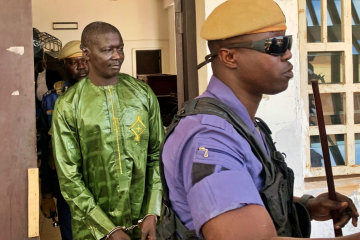
The detective charted the investigation from its inception to its conclusion, revealing how the urgent passport was not only approved but printed on the very same day. Drammeh subsequently used the document to travel outside the jurisdiction.
When the case was called yesterday, A. Badjie appeared for the State while A. Jarju represented the defence.
Before proceedings commenced, the State informed the court of an amendment to the bill of indictment, which included new charges. When these charges were read to the accused, he entered a plea of not guilty. The defence did not raise any objection to the amended charges.
During the session, the defence submitted an application requesting that all seven State witnesses who had previously testified in the matter be recalled. The State did not oppose this application.
The presiding judge subsequently ruled in favour of the defence and ordered that the witnesses be recalled to give further testimony.
In his testimony, Lamin Saidykhan informed the court that he’s a police officer and resides in Old Yundum. When asked by State Counsel whether he recognised the accused, Musa Sanyang, he responded in the affirmative
Detective Superintendent Lamin Saidykhan was asked how he recognised the accused. He responded: “I remember on the 3rd of February 2025, the office of the Inspector General of Police received a correspondence from the Gambia Immigration Department (GID) with a view to investigate the issuance of a passport to Mbemba Drammeh.”
Pressed further on whether he would recognise the correspondence from the Immigration Department if shown to him, Saidykhan answered in the affirmative. The document was then presented to him in court. After reviewing it, he confirmed that it was indeed the same correspondence sent to the office of the police chief.
State Counsel, who led the witness, asked whether the document shown was the original copy. Saidykhan replied: “This is not the original copy. The original copy should be with the Immigration Department, as they are the institution concerned.”
The State Counsel subsequently applied to tender the correspondence into evidence. With no objection raised by the defence, the document was formally admitted as an exhibit.
Superintendent Lamin Saidykhan, who led the police investigators in the matter, told the court that the accused was interviewed, and both cautionary and voluntary statements were obtained from him. He added: “Again, the Commissioner of the Passport Unit, along with other staff concerned, were later invited to give their accounts.”
Saidykhan continued: “It was during this investigation and interrogation that it was established the accused, Musa Sanyang, was the administrator at the Passport Unit.”
He explained that this discovery prompted investigators to intensify their inquiries. Together with the accused, officers visited the Passport Unit of the Gambia Immigration Department.
“The accused was asked whether he was the one responsible for the issuance of the said passport. However, we later uncovered that the accused was indeed the person responsible for issuing the passport,” Saidykhan told the court.
During testimony, Saidykhan told the court that Sanyang received information about the fugitive’s need for a passport through Musa Camara, who was later invited to assist investigators in establishing the facts. Investigators discovered that Camara had obtained a snapshot of Drammeh’s passport, which was then used to process a new document for him.
According to Saidykhan, Camara and Sanyang agreed on a fee of 40,000 dalasis to facilitate the process. Remarkably, the application, approval, and printing of the passport all took place on the same day, after the request was flagged as “urgent”, a development that raised serious questions about procedure.
Saidykhan explained that the police wrote to the Gambia Immigration Department (GID) after learning that Drammeh had left the country. Initially, the GID says a search conducted on their system regarding the alleged issuance of passport, had found nothing. However, they later admitted that a passport had indeed been issued.
The investigation further revealed that Sanyang had failed to conduct a thorough search to inform his superiors that Drammeh had been granted a passport. “Police subsequently visited the GID passport unit, where they discovered that Drammeh held a valid passport due to expire in 2027, as well as an expired one. Records showed that several passports had been issued to him over the years.”
During cross-examination, defence counsel Jarju questioned Saidykhan about his qualifications. The witness stated that he holds a BSc degree with a concentration in Physics and Law, and confirmed that he also possesses a foundational certificate in information technology.
Jarju pressed further, asking whether all the information gathered during the investigation had come from third parties. Saidykhan denied this, insisting that he had obtained evidence directly.
The defence counsel then asked whether investigators had seized the computer used for printing passports. Saidykhan confirmed that they had examined the PC used by the accused, and that this was done in the presence of Sanyang’s superior.
Jarju also asked whether Camara had provided an expired passport to process Drammeh’s application. Saidykhan acknowledged that he was aware of this fact.
The matter has been adjourned until 16 February, when cross-examination is expected to continue.