Tensions are boiling over in Jinack, after security forces arrested eight suspected smuggling agents accused of collaborating with foreign networks to facilitate irregular migration to Europe. The arrests followed a dramatic community-led crackdown in which residents rounded up more than 100 would-be migrants and handed them to immigration authorities, days after a deadly boat accident claimed several lives and left others missing.
Jinack has become a flashpoint in The Gambia’s migration debate. Outsiders accuse the community of enabling smuggling networks by allowing their island to serve as a transit hub. But villagers insist they are victims of circumstance, overwhelmed by the influx of migrants and powerless to stop the phenomenon.
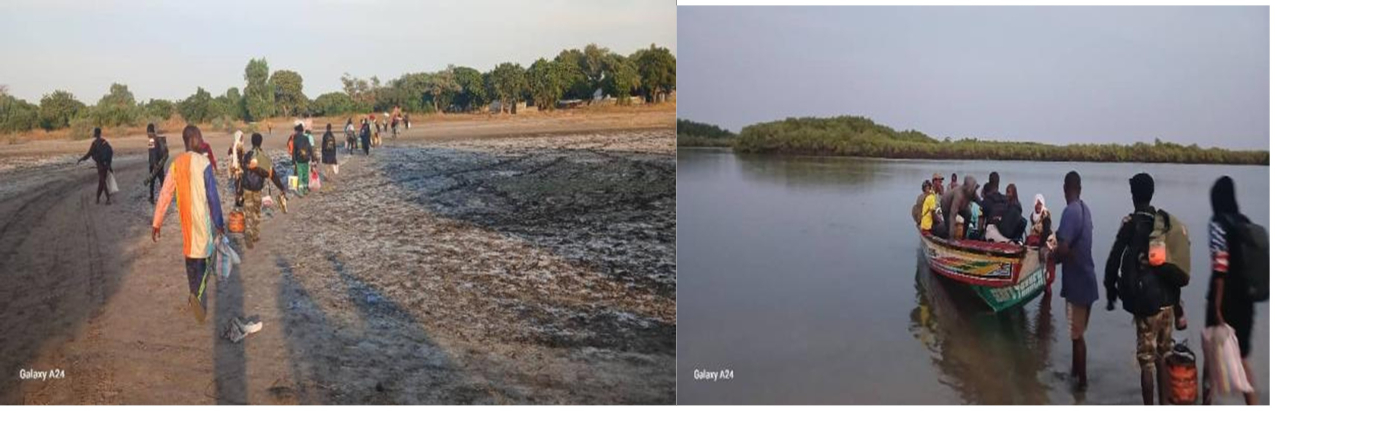
“We are not agents. These people come here on their own, and sometimes people lodge them in their compounds,” explained Lamin Manneh, a resident. He described how villagers mobilised on Monday, combing compounds and outskirts to gather migrants before escorting them in three canoes to immigration officers at Bakindiki Koto. “This is a clear indication that we are committed to fighting the phenomenon,” he said.
Economic strain and social burden
While the influx of migrants has temporarily boosted local trade, with visitors buying food and supplies, residents say the burden is heavy. “They will come to people’s homes asking for lunch and dinner. So, there is no choice but to assist them. This has increased the amount of money we spend on rice,” Manneh added.
Some locals admit that individuals may be indirectly involved, but stress that the majority are caught between smugglers and desperate migrants. “We are occasionally overwhelmed by the sheer number of people who arrive in the village,” said village alkalo Momodou Manneh, who emphasised that community members are actively sensitising migrants against the ‘backway’, even using Friday kuttabs to warn compound owners.
Taboo versus enforcement
Efforts to enforce migration laws face a unique obstacle: a longstanding taboo forbids uniformed personnel from entering Jinack. Many believe that officers who enter in full uniform risk being stripped, driven mad, or could even die. During The Point’s visit, security forces were present, but notably dressed in civilian clothing.
This cultural barrier raises questions about how the state can reconcile traditional beliefs with the urgent need for visible law enforcement. “There are no agents in the village. However, agents who are not Gambians may have established connections with some inhabitants,” the alkalo insisted.
For young men, transporting migrants from Barra to Jinack on motorbikes known locally as “Jakarta” has become a source of income. One rider revealed he could earn up to 3,000 dalasis in a single day during peak migration periods. “Since the accident, business has drastically declined. Now I sometimes close with just 900 or 1,300 dalasis,” he said, noting that riders typically charge 150 dalasis per passenger.
Cross-Border Suspicions
Villagers argue that Gambian and Senegalese security forces must collaborate more closely. “There is no way a boat carrying more than one hundred people could pass a Senegalese checkpoint at Jinack Barra without the authorities being aware of it,” one resident said. Some suspect Senegalese security of complicity with smuggling agents, underscoring the need for joint naval patrols.
The crisis in Jinack reflects a broader national tragedy. According to migrant activist Ebrima Drammeh, 893 Gambians lost their lives in 2025 — 840 at sea and 53 on land. Twenty-six boats disappeared without trace, with Gambians confirmed aboard each. From these alone, 730 Gambians vanished in the Atlantic, while another 74 went missing across desert routes and detention zones in North Africa. In total, 777 Gambians were declared missing or dead last year.
A Community Plea
For Jinack, the struggle is existential. Residents are calling for urgent government intervention to dismantle smuggling networks and prevent further loss of life. Yet the question remains: how can the state enforce migration laws in a community where tradition forbids the presence of uniformed officers?
As the island grapples with grief, suspicion, and survival, Jinack stands as a microcosm of The Gambia’s migration crisis, a place where desperation meets tradition, and where the fight against irregular migration is as much about culture as it is about law.
President Barrow Stands Firm
During a televised address to the nation on 3 January, following the tragic boat accident, the Gambian leader issued a stern warning that all individuals found culpable or involved in the deadly irregular migration incident off the coast of Jinack village would face the full force of the law. The nation continues to mourn the lives lost in yet another perilous ‘backway’ journey to Europe.
He further announced that the government will launch a comprehensive investigation into the incident.
While the government has announced its commitment not only to investigating the deadly boat tragedy but also to tackling irregular migration, particularly in Jinack where the island is being used as a transit point, the pressing question remains: how can these measures be enforced amid the lingering taboo that forbids uniformed personnel from entering the village?
Human rights point of view
Madi Jobarteh, a prominent human rights activist from the Edward Francis Small Centre for Rights and Justice, recently argued that migrants sustain the Gambian economy while the state fails to sustain its own people.
According to the Centre, remittances from Gambians in the Diaspora account for more than 30 per cent of the country’s Gross Domestic Product. “These funds support households, pay school fees, finance healthcare, sustain small businesses, and cushion families against economic shocks. Yet, despite benefiting immensely from this migration-generated income, the state has failed to create comparable opportunities at home that would allow citizens to live with dignity without risking their lives at sea.”
The Centre also rejects the narrative that only the poor and uneducated leave. It notes that both underprivileged youths and highly educated, skilled, and relatively privileged Gambians are seeking to exit the country through different routes. What unites them, the Centre argues, is not attitude but dire socio-economic conditions and limited prospects. “The real issue, therefore, is not whether migration is regular or irregular, but the conditions that justify and fuel it.”