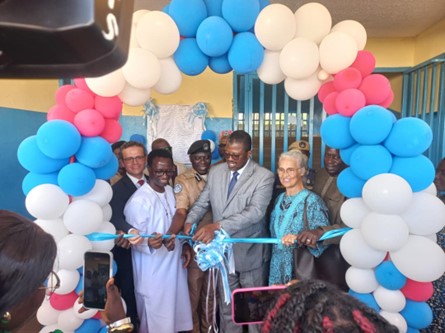
The newly inaugurated facility, a six-classroom block, was funded by MRC Holland Foundation in partnership with the Insight Training Centre. It is designed to expand vocational training capacity within Mile II and improve learning conditions for inmates engaged in skills development programmes.
The Turkish Cooperation and Coordination Agency (TIKA) also supported the project by providing training equipment, while Gambia Children First provided toolkits to graduates to help them start work upon release.
The graduation ceremony also observed inmates receiving certificates in construction, electrical installation, and other technical fields, marking the culmination of months of intensive vocational training under the Insight Training Centre programme.
Speaking on behalf of the President, the Minister for Defence, Baboucarr Ousmaila Joof, described prison reform as both a policy priority and a moral obligation, stressing that government’s vision is to ensure correctional facilities promote human dignity while preparing inmates for life after release.
He announced that inmates who participated in the construction of the classroom block would each receive D10,000 as recognition of their contribution.
“This initiative is part of government’s commitment to rehabilitation and reintegration,” he said, adding that prisons must not only punish but also restore individuals to productive citizenship.
Director General of the Gambia Prison Service, Ansumana Manneh, described the project as a symbol of transformation within the prison system.
“We are not only celebrating infrastructure today, but also resilience, hope and the power of education,” he said.
He noted that the Prison Service, in collaboration with partners, has been implementing Security Sector Reform initiatives focused on rehabilitation and skills acquisition, adding that nearly 300 inmates have benefited from such programmes over the years.
According to him, the latest cohort includes 50 graduates, made up of 48 inmates and two prison officers trained in construction, electrical installation, and related vocational disciplines.
Manneh further revealed that the Insight Training Centre has now trained a total of 348 inmates since 2012, many of whom have successfully reintegrated into society as skilled workers, entrepreneurs, and contributors to national development.
The Director General of the Insight Training Centre, Ismaila Ceesay, described the occasion as a demonstration of how correctional education is reshaping lives.
He said the programme goes beyond certificates, focusing on discipline, moral development, entrepreneurship, and practical skills that enable inmates to reintegrate successfully after release.
“This is not just training; it is transformation,” he said, noting that graduates are emerging as electricians, builders, tailors, and solar technicians capable of supporting themselves and their families.
He also highlighted that the centre has expanded training across multiple prison facilities nationwide, ensuring equal access to vocational education for inmates in different regions.
Dr Omar Barry, Board Director of the Insight Training Centre, described the occasion as more than a graduation ceremony, calling it a “testament of human transformation.”
“Today, we do not merely celebrate certificates; we celebrate hope,” he said. “What is happening here is a quiet revolution in how we understand justice.”
He explained that the programme challenges traditional perceptions of prisons by focusing on correction, education, and reintegration rather than punishment alone.
Chairperson of Gambia Children First, Nella Helen, also addressed the gathering, encouraging graduates to see themselves as capable of change and reintegration into society.
She noted that the foundation has supported the programme for several years and has witnessed ex-inmates successfully rebuilding their lives through skills acquired in prison.
“You are not defined by your past mistakes. You are defined by the new choices you make today,” she told the graduates.
Minister for Higher Education, Prof. Pierre Gomez, reaffirmed government’s commitment to Technical and Vocational Education and Training (TVET), stating that skills development remains central to national development planning.
He disclosed that government is expanding investment in vocational education, including within correctional institutions, to ensure that no citizen is excluded from opportunity.
“Education does not end behind prison walls,” he said, adding that skills training helps restore dignity and reduce recidivism.
Coordinator of the MRC Holland Foundation, Henriette Brummer Sonko, highlighted the importance of collaboration, noting that inmates themselves contributed directly to the construction of the facility.
“They did not only learn how to build, they built it,” she said, describing the project as a product of partnership and shared responsibility.