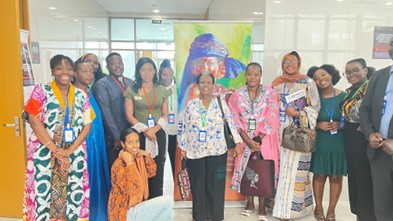
The concerns were raised on Tuesday during a high-level side event titled “From Survival to Structural Change: Solidifying the Path to Justice and Accountability for Conflict-Related Sexual Violence in the Horn of Africa,” held at the Sir Dawda Kairaba Conference Centre on the margins of the 87th Ordinary Session of the African Commission on Human and Peoples’ Rights.
Speaking during the panel discussion, Sudanese activist Nodal Kabashi painted a grim picture of the ongoing violence in Sudan, where fighting between the Sudan Armed Forces and the Rapid Support Forces (RSF) has plunged the country into civil war and triggered widespread atrocities against civilians, particularly women.
Kabashi said many women and girls have been left vulnerable as hospitals shut down, schools closed and communities collapsed under the weight of the conflict.
“Women are forced to move from one place to another searching for food and safety, but in many cases they become victims of beatings, rape and sexual harassment,” she said.
According to her, some survivors remain in hiding and silence due to fear, stigma and the absence of protection systems.
She further explained that the violence has spread across borders into South Sudan, where tribal divisions and armed movements have intensified attacks on women and girls.
“The popular movements kidnapped girls and women and subjected them to sexual violence. Sexual brutality is now becoming a norm in conflict,” she stated.
Kabashi revealed that community groups and women-led organisations are now relying on early warning systems and safe shelters to protect vulnerable women.
“We send alerts to women in danger and move them to safer locations. More than 200 women have already been protected through these efforts,” she added.
Ethiopian activist Worknesh Begi also highlighted the devastating impact of conflict in Ethiopia, particularly in regions affected by fighting between government forces and armed groups.
She said mass displacement, communication blackouts and shrinking civic space have made it nearly impossible for survivors to access justice or medical support.
“Gang rape, sexual harassment and sexual slavery have become widespread, yet no one comes to our aid,” Begi lamented.
She disclosed that some victims became pregnant after being gang raped, while schools were converted into military camps and farmers lost access to markets due to insecurity.
Begi further criticised the lack of support for women-led organisations, saying many local groups lack the funding needed to reach survivors and document abuses.
“Women’s organisations cannot even connect with the victims because of the insecurity and lack of resources,” she said.
Nancy Raphael, a South Sudanese activist, said women and girls continue to suffer horrific abuses amid ongoing instability in South Sudan.
She recounted incidents dating back to 2017 where women were raped at gunpoint and subjected to repeated violence within their own communities.
“The fear has limited women’s access to healthcare and protection. The systems that should protect them are failing,” she stated.
Despite the challenges, Nancy said women remain at the forefront of supporting survivors, even though they are largely excluded from peace negotiations and decision-making processes.
“Young women are facing enormous barriers. They need psychosocial support, safe spaces and opportunities to participate in leadership and peacebuilding,” she said.
In South Sudan, girls are often viewed as a source of income, with some fathers arranging marriages for their daughters to men as old as 50 or 60 years. In many cases, mothers who support their daughters and oppose such marriages face threats, beatings, or even arrest. “Justice means a lot to me,” she said.
She also urged the media to play a more active role in challenging harmful cultural norms that perpetuate violence and discrimination against women.
Meanwhile, lawyer Ruth Ohbewekon of the Pan African Lawyers Union (PALU) stressed that conflict-related sexual violence remains one of the most silenced crimes globally, particularly when committed against African women.
“Conflict-related sexual violence is still treated as a taboo, and that is one of the biggest obstacles to justice,” she said.
Ohbewekon argued that the international legal system has failed many African women survivors and called for stronger global accountability mechanisms.
“The pathways to justice are extremely difficult, especially for Black African women. It is an uphill battle,” she stressed.
She warned that cuts in international funding for justice and human rights initiatives could further weaken efforts to support survivors and pursue accountability.
The PALU lawyer also called on the International Criminal Court (ICC) and international actors to intensify efforts to document evidence and preserve case files for future prosecutions.
“How do we work together to help victims get justice? Can we collect evidence now in a way that will support future accountability?” she questioned.
Participants at the event repeatedly emphasised that beyond humanitarian assistance, structural reforms, justice mechanisms and survivor-centred approaches are urgently needed to end the cycle of impunity surrounding sexual violence in conflict zones across the Horn of Africa.
Hon. Janet Ramatoulie Sallah-Njie, Special Rapporteur on the Rights of Women in Africa at the African Commission on Human and Peoples’ Rights, emphasised the significance of efforts by the African Commission and the African Union in documenting human rights violations in Sudan.
She noted that in January 2026, the Joint Fact-Finding Mission on the Human Rights Situation in the Republic of Sudan, led by the African Commission in partnership with the African Union Department of Political Affairs, Peace and Security (DPAPS), carried out a field mission to Chad, where members directly engaged victims and survivors who had fled the conflict in Sudan.
According to her statement, testimonies collected from victims, survivors and witnesses revealed alarming and systematic acts of violence targeting civilians, including widespread conflict-related sexual violence.
She explained that the mission built on the earlier work of the Virtual Joint Fact-Finding Mission on the Human Rights Situation in Sudan conducted in 2025 by the African Commission and the African Union Commission’s Department of Political Affairs, Peace and Security. The initiative later resulted in a comprehensive report presented during the 85th Ordinary Session of the African Commission.
The report, she said, exposed grave patterns of conflict-related sexual violence, including rape, gang rape, sexual slavery, forced marriages and sexual exploitation committed during the ongoing conflict. It further highlighted that such abuses were frequently used as weapons of war, with women and children continuing to suffer the greatest impact of the violence.
She further stated that the findings demonstrated how longstanding impunity and structural violence have contributed to the continuation of such abuses over the years. The report underscored that the failure to hold perpetrators accountable for past atrocities, coupled with weak transitional justice mechanisms, created an environment in which cycles of violence could continue and reoccur.