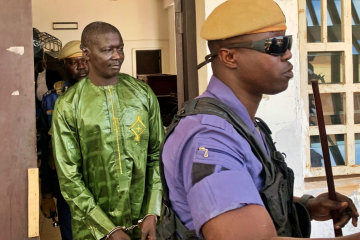
Kandeh, a senior official of the Malaria Control Programme (MCP), is standing trial alongside two other accused persons over allegations of corruption, forgery, disobedience of statutory rules and causing economic loss to the Government of The Gambia.
Testifying as DW1 before Justice Ebrima Jaiteh, Kandeh told the court that he did not hire any consultants linked to the disputed malaria studies and had no dealings with individuals whose CVs were allegedly forged and used to justify payments.
He said the first time he came across the CVs of Muhammed Sisawo, Basiru Phillot and Abou Sallah was during police investigations at the Police Headquarters.
The prosecution has alleged that the three accused persons conspired with officials of the NGO Health Emergency Preparedness and Development Organisation (HEPDO) to engage “purported consultants,” forge documents and unlawfully obtain public funds between 2018 and 2020.
Kandeh is facing multiple counts, including official corruption, disobedience to statutory rules under the Gambia Public Procurement Act, obtaining documents by false pretences, forgery, stealing, and causing an economic loss amounting to D11,470,023.04.
He is also accused of being involved in the alleged theft of D2,934,357.12.
In his testimony, Kandeh denied each of the charges, insisting that his role was purely administrative.
He said his responsibility was limited to signing a memorandum of understanding (MoU) between the Ministry of Health and HEPDO, as well as a technical MoU between MCP and HEPDO, which outlined programmatic and financial arrangements for malaria-related studies.
“I did not hire any consultant, and it was not my responsibility to do so,” Kandeh told the court. He added that NGOs such as HEPDO operated independently and that MCP had no authority over how partner organisations recruited consultants.
On the charge of disobedience to procurement laws, Kandeh said the Public Procurement Act did not apply to the MOU, as it was an agreement with an independent NGO rather than a direct government procurement process.
He also rejected allegations of economic loss, arguing that the malaria studies conducted under the HEPDO agreement benefited the country.
According to him, the studies helped The Gambia qualify for new-generation insecticide-treated bed nets introduced by the World Health Organisation, leading to millions of dollars in funding and supplies from the Global Fund.
Kandeh also denied forging any CVs or obtaining MOUs by false pretences, stating that he never dealt with Basiru Phillot, who testified for the prosecution. He said any payments allegedly made to consultants were handled by HEPDO officials and not by him.