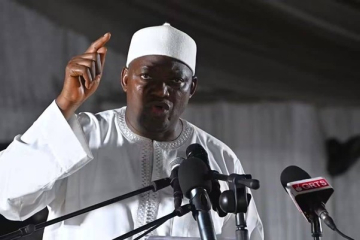
Speaking on West Coast Radio Coffee Time show, Dr Ceesay said the move is intended to replace illegal cannabis farming with alternative economic activities while also strengthening security presence on the island.
According to the minister, law enforcement agencies recently carried out an operation at the Gambian parts of Jinack, where cannabis farms were destroyed. “The operation targeted Jinack Nigi and Jinack Kajata, two of the four Jinacks that exist in the region, with the other two located in Senegal,” he said.
“The exercise took place on February 28 and March 1 and resulted in the destruction of 60 cannabis farms. Officers also discovered 14 bags of cannabis which were burned during the operation.”
Dr Ceesay praised the Drug Law Enforcement Agency for leading what he described as a successful mission to enforce the law and protect public safety.
“You know Jinack has been renowned for cannabis cultivation for decades, but government sees the belief that law enforcement cannot enter Jinack as a misconception.”
He said the long-standing belief that officers would suffer misfortune if they entered the island proved to be false.
When asked whether officers entered the island wearing uniforms, the minister confirmed they did.
“This was a myth, they went with uniforms and so far there is no misfortune against those officers that went,” he stated.
Beyond the enforcement action, the government now plans to introduce development programs aimed at changing the economic situation in the island communities.
Dr Ceesay said many residents had depended on cannabis farming for years because it was their only source of livelihood. To address this, “the government intends to help people” transition into other economic activities, he said:
“One of the measures being considered is the provision of fishing boats to villagers interested in fishing as an alternative source of income. The government also plans to electrify the island communities as part of its national drive towards universal access to electricity.”
“Government is going to electrify both villages,” the minister said, noting that the project will begin as soon as possible. He added that electricity will help expand business opportunities and improve access to services.
Security presence will also be strengthened through the construction of a police station on the island.
According to Dr Ceesay, the move is intended to ensure permanent law enforcement presence to deter cannabis cultivation and also address concerns that the island has sometimes been used as a hub for irregular migration.
“We are not only enforcing law by destroying cannabis farms,” he said, “we are also supporting them to diversify livelihoods by providing fishing boats and other support, and making sure we electrify the whole of Jinack.”
During the interview, the minister also addressed reports of suspected fuel contamination at the country’s main fuel depot.
He said the matter is currently under investigation by the Public Utilities Regulatory Authority after fuel marketers raised concerns about possible contamination.
“They are taking samples and assessing where it has happened, the extent to which it has happened and why it has happened,” Dr Ceesay said.
He added that government will wait for the outcome of the investigation before making further comments, noting that it would be unwise to speculate until laboratory testing confirms whether the fuel is indeed contaminated.
Dr Ceesay also commented on the ongoing corruption trial involving a former lands minister, saying the case should give Gambians confidence that systems are now in place to detect and prosecute corruption.
“What it should do is give people hope that government is doing something to fight corruption,” he said.
He maintained that the government had adopted a zero-tolerance approach to corruption and would take anyone to court with sufficient evidence against them.
The minister further reacted to the recently announced Trifurcation Accord by APEX among some opposition parties, saying the agreement confirmed government claims that opposition groups often engage in insults and hostility towards one another.
According to him, the accord essentially calls on its signatories to stop insulting each other, which he said showed that such behaviour had become a problem within the opposition.
Despite his criticism, Dr Ceesay said he welcomes any effort that seeks to reduce hostility in politics.
“I like it because we have no place for acrimony and insults and hostility in our politics,” he said.