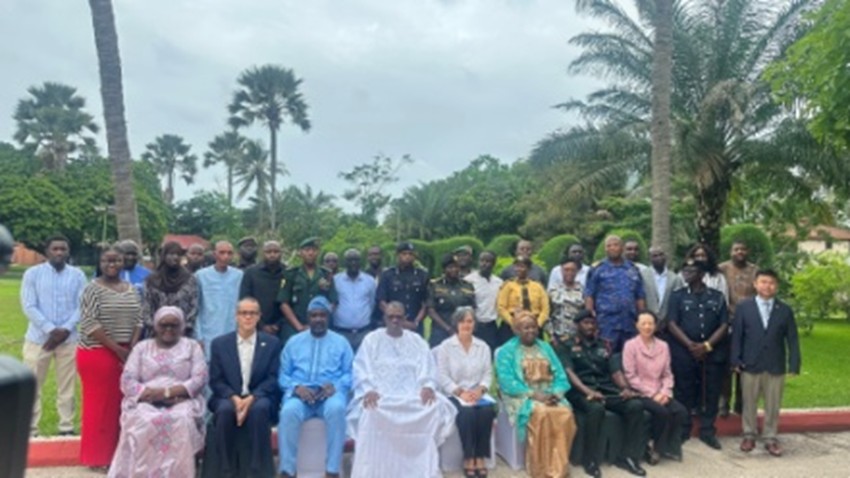
The initiative seeks to strengthen awareness among relevant national stakeholders, facilitate the exchange of information on roles and experiences related to UNSCR 1540, and identify areas for future dialogue, capacity-building, and technical assistance.
The workshop examined existing legislative and institutional frameworks, to identify implementation gaps, improve communication and information-sharing among stakeholders, and develop practical recommendations to enhance The Gambia’s national implementation architecture.
Defence Minister Baboucarr Ousmaila Joof in his opening remarks, said that the initiative was an important step in reinforcing The Gambia’s national resilience against emerging security threats.
He noted that while The Gambia neither possesses nor produces weapons of mass destruction, its strategic location on the West African coast, expanding maritime domain, international airport, seaports, and land borders make it essential to establish robust measures against illicit trafficking and proliferation activities.
“The implementation of Resolution 1540 is not only about meeting international obligations; it is about protecting our citizens, safeguarding our institutions, and strengthening our national security architecture,” he said.
He stressed that effective implementation of the resolution requires a whole-of-government approach involving ministries, departments, agencies, parliament, the private sector, academia, civil society, and international partners.
Director and Deputy to the High Representative for Disarmament Affairs at UNODA, Adedeji Ebo, commended The Gambia for its commitment to the process and for convening stakeholders from across national institutions.
He explained that UNSCR 1540, adopted unanimously by the UN Security Council in 2004, obliges all UN member states to adopt and enforce measures preventing non-state actors from acquiring, developing, possessing, transporting, transferring, or using nuclear, chemical, or biological weapons and their means of delivery.
“Effective national implementation requires the contribution of many different actors, including security institutions, customs and border authorities, regulatory bodies, trade and licensing authorities, public health institutions, scientific and technical communities, and other relevant stakeholders,” Ebo said.
He added that the risks posed by non-state actors are particularly acute in West Africa and the Sahel, where illicit trafficking networks, organised crime, and porous borders increase the possibility of proliferation-related threats.
The European Union Ambassador to The Gambia, Immaculada Roca I. Cortés, reaffirmed the EU’s commitment to supporting the universal and effective implementation of Resolution 1540.
She revealed that since 2006, the EU has provided more than €6 million to support global and regional disarmament and non-proliferation activities, including legal and regulatory reforms, border management, export controls, and scientific security initiatives.
Describing The Gambia’s request for assistance to the 1540 Committee, submitted in May 2026, as a significant milestone, Cortés said it demonstrated national ownership and determination to translate international obligations into practical national action.
“This is not only about compliance with international commitments; it is also about strengthening the legal, regulatory, and institutional capacities that underpin national security and resilience,” she stated.