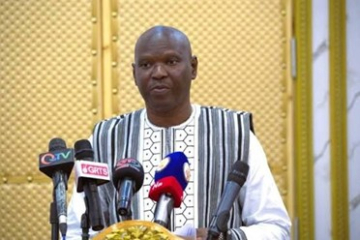
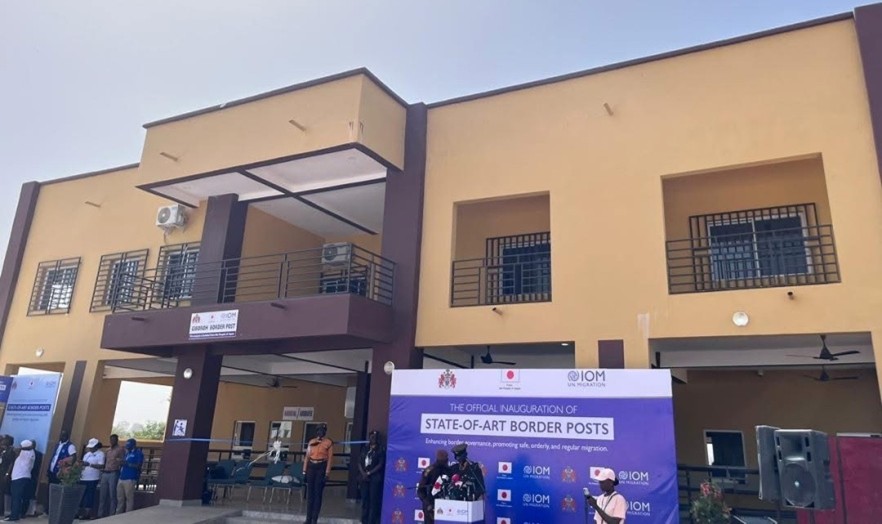
Speaking at the ceremony in Giboro Koto, the Minister for Interior, Abdoulie Sanyang, said the project reflects the government’s unwavering commitment to protecting the integrity of national borders while modernising immigration services in line with international standards.
He emphasised that the achievements recorded by the Gambia Immigration Department (GID) continue to benefit from the strong political backing of President Adama Barrow, whose leadership, he said, has prioritised secure national systems and institutional reform.
“In pursuit of our vision for a secure national document and identity management system, we continue to enjoy the strong support of His Excellency President Adama Barrow,” Minister Sanyang stated.
The minister highlighted the recent signing of a Public-Private Partnership agreement with Margins ID Group, aimed at transforming The Gambia’s national identity management system through the introduction of a digital ID. He described the digital ID as a strategic national asset that will enhance financial inclusion, improve public service delivery, foster transparency, and lay the foundation for a thriving digital economy.
According to him, a secure digital identity system will empower citizens and accelerate national development in the 21st century, while complementing efforts to strengthen border control.
Minister Sanyang urged GID management and officers assigned to the new facilities to maintain the infrastructure responsibly, stressing that the facilities are public assets that must be preserved in line with government internal control standards.
He also paid tribute to the Inspector General of Police, Seedy Touray, who initiated the project during his tenure as Director General of Immigration, and commended General Procurement Services for delivering what he described as “high-quality and beautiful structures.” Appreciation was further extended to the International Organization for Migration (IOM) for its technical leadership and support.
For his part, Mr. Ebrima Mboob, Director General of the Gambia Immigration Department, said the new border posts represent a major boost to efficiency, professionalism, and service delivery.
He reaffirmed the Department’s readiness to collaborate with national institutions, development partners, and local communities to ensure dignified, transparent, and professional immigration services.
Mr. Mboob expressed gratitude to the Ministry of Interior, President Barrow, regional authorities, and the Alkalos of Giboro, Kerr Ali, and Amdallai, whose cooperation, he said, was instrumental to the project’s success. He also commended GID staff and senior management for their resilience and dedication.
“The history we make today will resonate far beyond these walls and be recounted for generations to come,” he noted.
The project aligns with Goal 3: Enhancing Border Control and Management, aimed at curbing irregular migration, cross-border crime, and other migration-related threats. It also reflects The Gambia’s evolving approach to migration governance, emphasising efficiency, security, and responsibility.
Mr. Mboob noted that with continued support from IOM, the Department remains committed to sustaining the facilities, strengthening partnerships, and ensuring long-term impact.
Through support from the UN Peacebuilding Fund, IOM has facilitated the construction of the Tabanding Border Post, established Inter-Agency Border Coordination Committees (IABCC) nationwide, and expanded the Migration Information and Data Analysis System (MIDAS) to ten official border crossing points, significantly improving migration data collection and analysis.
Speaking on behalf of IOM, Ms. Aissata Kane, Chief of Mission for Senegal with Coordination Functions for The Gambia and other countries, described the inauguration as a historic milestone made possible through the generous support of the Government of Japan.
She said the new border posts equipped with surveillance systems, solar power, boreholes, gender-inclusive sanitation, and ten MIDAS workstations each would promote safe, orderly, and regular migration while discouraging irregular crossings.
Japan’s Ambassador to The Gambia, H.E. Takeshi Akamatsu, said effective border management is critical at a time when West Africa faces serious security threats, including terrorism and transnational crime. He revealed that the project also provided specialised training to over 1,300 border officials.
“Strengthening border security does not mean restricting movement,” the Ambassador said, noting that reliable systems facilitate safe mobility for more than 800,000 travelers annually while promoting lawful trade and regional cooperation.
The inauguration was punctuated by cultural performances and marked a renewed commitment by the Government of The Gambia and its partners to building secure borders, safe mobility, and sustainable peace.