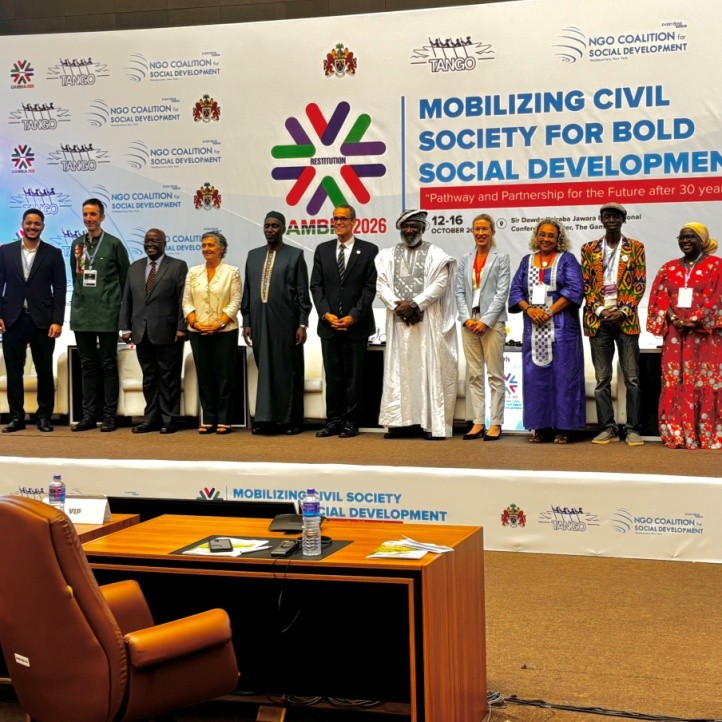
The Gambia on Monday hosted a five-day summit bringing together civil society organisations, government representatives and development partners to strengthen partnerships and advance the implementation of global commitments on social development.
The 2026 Gambia NGO Restitution Summit on Social Development, organised by the NGO Coalition for Social Development and its partners, runs from October 12 to 16 at the Sir Dawda Kairaba Jawara International Conference Centre in Bijilo.
Held under the theme, “Mobilising Civil Society for Bold Social Development: Pathways and Partnerships for the Future After 30 Years,” the summit provides a platform for stakeholders to examine the 2025 Doha Outcome on Social Development and identify practical ways of translating international commitments into meaningful improvements in people’s lives.
Participants include government officials, parliamentarians, United Nations agencies, non-governmental organisations, development partners, youth and women’s groups, persons with disabilities, academics, religious leaders and human rights activists.
Chairperson of TANGO, Mrs Yadicon Njie Eribo, said the challenge was no longer simply agreeing on development priorities but ensuring that commitments were implemented, progress measured and the voices of vulnerable communities reflected in decisions affecting their future.
She said the summit offered civil society an opportunity to move from commitments to implementation, strengthen coordination and ensure that people affected by poverty and inequality had greater influence over development outcomes.
According to her, The Gambia faces persistent challenges, including poverty, limited employment opportunities, unequal access to essential services, climate vulnerability and the exclusion of marginalised communities.
She stressed that social development must create opportunities for young people to secure decent employment, enable women to participate in leadership and decision-making, and ensure that persons with disabilities could access public services, employment and civic spaces without discrimination.
European Union Ambassador to The Gambia, Immaculada Roca i Cortés, reaffirmed the EU’s commitment to working with the government and civil society to advance sustainable development.
She said civil society organisations needed an enabling environment, opportunities to contribute to decisions affecting their communities and support to strengthen their organisational capacities.
Roca i Cortés also emphasised the importance of women’s and young people’s participation, noting that inclusive development required ensuring that opportunities were available to all generations.
She said partnerships between civil society, government authorities and development partners were essential to turning commitments into action.
Executive Director of ActionAid International The Gambia, Ndella Faye Colley, called for social development approaches that addressed the root causes of poverty and inequality rather than merely responding to their consequences.
She said meaningful development required challenging structures that marginalised people and ensuring that women, young people and persons with disabilities had a genuine voice in decisions affecting their lives.
Colley also called for fair financing, meaningful participation and stronger accountability in the allocation of resources, stressing the importance of empowering grassroots communities to claim their rights and influence development policies.
Representing the Vice President, Baboucarr Boye of the Ministry of Public Service, Administrative Reforms, Policy Coordination and Delivery, described civil society organisations as a vital link between government policies and the communities they serve.
He said NGOs helped translate international commitments into community-level programmes and held governments and development partners accountable for their promises.
Boye further stressed that development strategies for least developed countries must be nationally owned and aligned with local priorities.
He cautioned that graduation from least developed country status should not lead to an abrupt withdrawal of international support, noting that countries could remain vulnerable despite changes in classification.
He urged development partners to maintain solidarity and ensure that challenges such as climate change, food insecurity and digital inequality do not undermine development progress.
The summit is expected to strengthen cooperation among stakeholders and advance practical approaches to inclusive and sustainable social development.