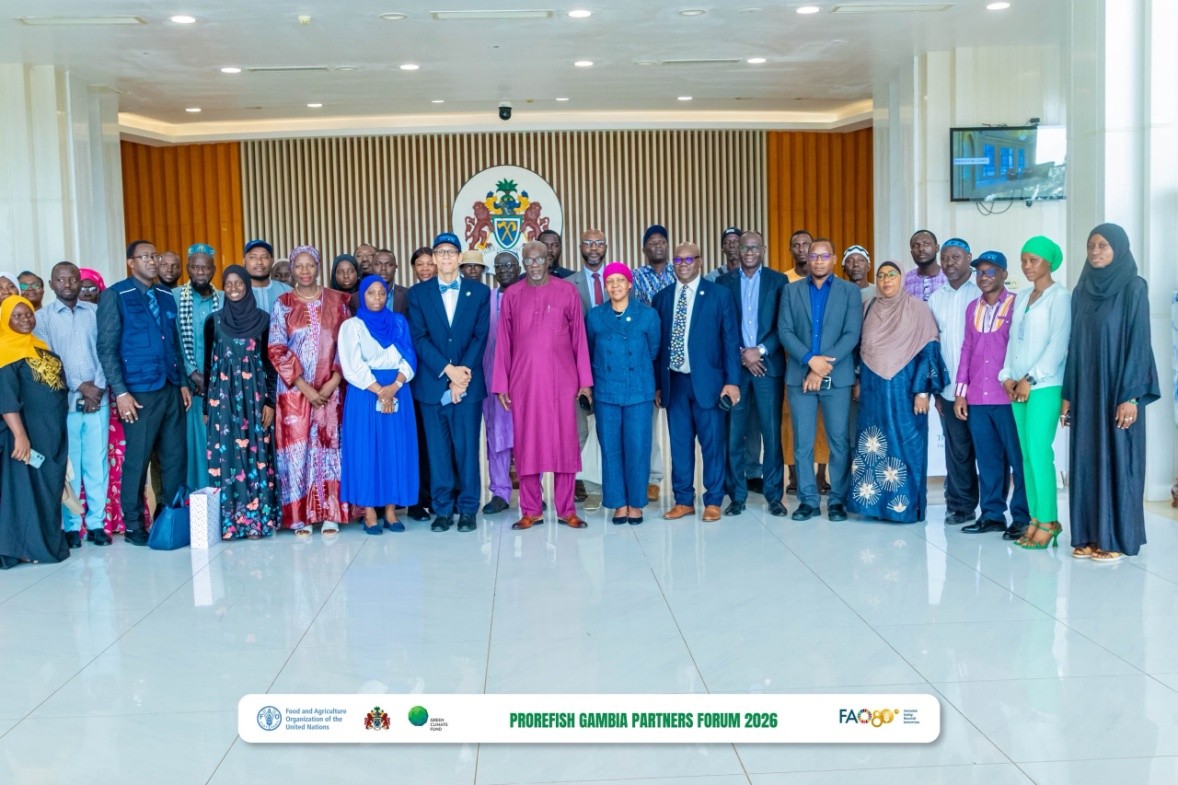
Held at the Sir Dawda Kairaba Jawara International Conference Centre in Bijilo under the theme “Resilient Fisheries and Ecosystem: Progress and Partnerships,” the forum brought together government officials, development partners and fisheries stakeholders to review progress under the Climate Resilient Fishery Initiative for Livelihood Improvement in The Gambia (PROREFISH Gambia) and strengthen collaboration as implementation advances.
The six-year initiative is financed by the Green Climate Fund with a total investment of US$25 million, including US$17.2 million in grant financing. Implemented by FAO in partnership with the Ministry of Fisheries, Water Resources and National Assembly Matters, the project directly targets 167,643 Gambians who depend on the fisheries value chain, over half of them women, while benefiting another 250,000 people indirectly.
Speaking on behalf of the Minister of Finance and Economic Affairs, Director of Climate Finance and Development, Isatou F. Camara, said climate change continues to threaten The Gambia’s fisheries sector through rising sea levels, increasing ocean temperatures and changing weather patterns.
She described fisheries as a pillar of the Gambian economy that supports thousands of livelihoods while contributing significantly improving food and nutrition security, employment and household incomes.
“Investing in resilient fisheries is no longer optional; it is essential,” she said, adding that PROREFISH demonstrates how climate finance can deliver tangible benefits to communities while advancing national development priorities.
FAO Representative to The Gambia Shibu Rampedi described PROREFISH as a nationally led initiative that is helping communities adapt to climate change by restoring degraded mangrove ecosystems, improving climate-resilient fisheries infrastructure and strengthening adaptive capacities.
She said hundreds of hectares of degraded mangroves have already been replanted and are showing encouraging survival rates, helping restore important breeding grounds for fish.
Rampedi also revealed that solar fish dryers at Brufut, Tanji, Sanyang and Kartong are nearing completion and are expected to reduce post-harvest losses, improve fish quality and increase incomes for women engaged in fish processing and marketing.
United Nations Resident Coordinator Karl-Frédérick Paul said the project’s benefits extend beyond fisheries, noting that improved livelihoods contribute to better nutrition, stronger local economies, gender equality and environmental protection.
Minister of Fisheries, Water Resources and National Assembly Matters Musa Drammeh said the forum provided an important opportunity for partners to review progress, identify challenges and strengthen coordination.
He reaffirmed government’s commitment to transforming the fisheries sector into a modern, inclusive and climate-resilient industry capable of creating jobs, generating wealth and supporting sustainable economic growth.