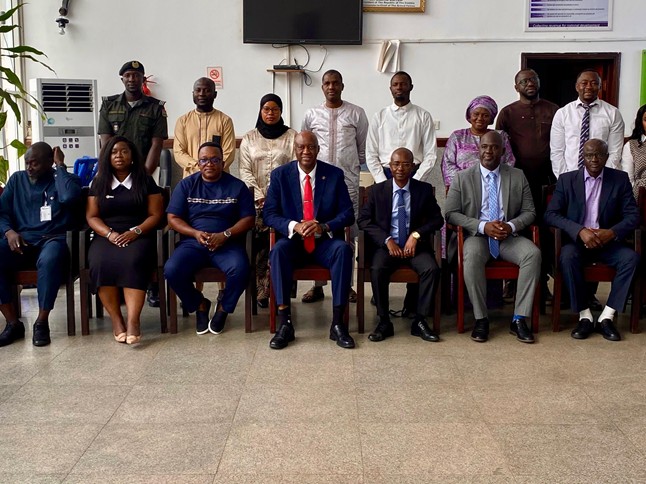
Commissioner General Yankuba Darboe in his welcoming remarks, said the tour comes at a time when the GRA continues to consolidate major reforms that have already transformed tax excise administration and strengthened compliance across industries. He highlighted that the success of these programmes rests on a strong legal framework, close collaboration with stakeholders and a nationwide enforcement strategy that leaves no room for tax evasion.
CG Darboe described enforcement as the backbone of the entire system, noting that GRA created a dedicated enforcement team, equipped it with offices, logistics and mobility, and ensured its presence throughout the country.
Darboe said smuggling of cigarettes, alcoholic beverages, soft drinks and fuel has reduced to the barest level since the introduction of the digital excise stamp and fuel marking systems. The reforms, he added, have boosted domestic revenue collection while promoting fairness in the business environment. He noted that businesses which initially resisted the reforms now advocate for them because they have experienced increased market confidence and improved sales under a more regulated system.
The GRA Commissioner General also explained that the fuel marking programme ended long-standing problems of illegal night deliveries and the misuse of concessions in the petroleum sector. According to him, the system has brought transparency and accountability to fuel importation and distribution, to the point where revenue from the sector has doubled.
He further announced that GRA, in partnership with PURA, is now at an advanced stage of introducing a telecom revenue assurance platform that will allow the Authority to verify VAT and excise obligations from mobile network operators based on actual call and data traffic. He described the move as an effort to ensure transparency in a critical sector, adding that “it is time to give Caesar what belongs to Caesar.”
Speaking during the engagement, the General Manager of SICPA Gambia, Momodou Clarks Jarra, commended GRA for the progress recorded under the excise project, describing The Gambia’s approach as a clear demonstration of modern tax administration. He said the visit would allow the Sierra Leonean team to appreciate how digital systems operate in real-time, from production lines to market monitoring and fuel distribution networks.
Kemo Sonko, GRA’s project manager, also underscored the importance of collaboration between institutions. He said excise reforms succeed only when the Ministry of Finance, the revenue authority and the concessionaire work hand-in-hand. He encouraged the visiting team to ensure that all NRA staff participate actively in the implementation of their national systems, noting that no project team can achieve lasting results in isolation.
The Team Leader of the Sierra Leone delegation Moo-usa Salia Konnei expressed deep appreciation for the reception accorded to them. She said she had not expected the level of organisation and coordination displayed by the GRA, noting that The Gambia has increasingly become a reference point for countries seeking practical lessons on revenue digitalisation.
While Sierra Leone introduced its excise stamp system in 2024, she acknowledged that enforcement gaps and smuggling continue to pose challenges. She said their visit is motivated by a desire to understand how The Gambia succeeded in tightening enforcement and maintaining compliance across sectors.