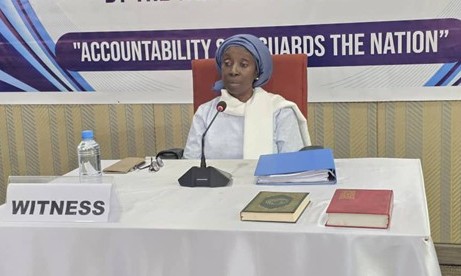
Reflecting on Section 201 of the Constitution and the Commissions of Inquiry Act, Bensouda walked the committee through the legal distinctions between an establishment and a mechanism. An establishment, she said, “is provided for by statute, is permanent, and forms part of the government’s structure with its own budget, functions, and committees. A commission of inquiry, however, is simply a mandate, a task given to a few individuals to investigate and report back.”
She argued that once such a commission submits its report, it becomes functus; that is, its work is complete and it ceases to exist. “That’s why we call it a mechanism,” she told the committee. “An establishment must be wound up, but a commission simply ends once its task is done.”
Pressed by counsel on whether the existence of a chairperson in the commission gave it the characteristics of an establishment, Ms Bensouda disagreed. “It makes no difference,” she said. “Having a chairperson doesn’t transform a mechanism into an establishment. The chairperson is only a presiding officer, not a superior authority.”
The discussion deepened into legal intricacies, with the committee’s counsel arguing that the chairperson of a commission wields distinct powers under Section 2(3) and Section 8 of the Commissions of Inquiry Act - such as excluding individuals for the due conduct of the inquiry, and exercising a casting vote when commissioners are deadlocked.
But Ms Bensouda held her ground, saying: “A casting vote is simply a procedural tool; it doesn’t confer superiority or extra power. The chairperson remains just a spokesperson for the group, not a higher authority.”
When asked about her own role at the Janneh Commission, she clarified her position in unmistakable terms. “I was not the head of the investigation team; I was lead counsel responsible for legal advice, coordination, and presentation of evidence to the commissioners.”
She referenced her letter of engagement to underline her point. “It clearly states that responsibility for advice and services under the letter was my sole responsibility,” she stated. “No other individual or entity assumed responsibility or liability for the services provided. I was the counsel to the commission, and all others worked under my direction.”
However, she noted that the investigators mostly drawn from the Office of the Inspector General of Police and the Financial Intelligence Unit (FIU) were independent professionals. Her role, she said, was to “coordinate investigations, ensure the quality of evidence, and guide investigators on accessing relevant materials, including those beyond the jurisdiction”.
Throughout the session, the exchanges between Ms Bensouda and the committee’s counsel were spirited but respectful, revealing both the legal complexity and institutional misunderstandings surrounding the Janneh Commission’s operations.
The former Lead Counsel maintained her stance with composure “The Commission of Inquiry was never an establishment. It was a mechanism, a legal mandate, a temporary tool for truth-seeking. Once our work was done, we ceased to exist. That is the law.”